Monday, June 16, 2008

Photography Redux or the Randomness of a Monday Morning

I am always impressed by those who have photographic vision, though I am always at some pains to grasp exactly what it is about that kind of seeing, if it exists at all. Photographic seeing if it exists allows a photographer to capture a moment in history. That captured moment can entertain us, horrify us or educate and enlighten us. The more talented the photographer, the more we are made aware of the world around us. Photographic vision not only allows us to see more of the world, but allows us to see through different eyes. Henri Cartier-Bresson whose work spanned the 20th century, Margaret Bourke-White who worked primarily before 1950 and Cindy Sherman, a currently living and active artist are three photographers, who capture what I appreciate about photographic vision.

Henri Cartier-Bresson was present at many important events of the 20th century, from the Spanish Civil War, to the German occupation of France, the partition of India and the Chinese revolution, Cartier-Bresson was a photojournalist of the highest rank. Throughout most of his photographic career there was one constant, his Leica 35mm. The French novelist and critic Andre Pieyre de Mandiargues once said that Cartier-Bresson used his Leica "rather as the Surrealists tried to use automatic writing: as a window that leaves one permanently open for visitations of the unconscious and the unpredictable" (Ebony 2004, 188). Cartier-Bresson in his most famous collection The Decisive Moment, sought to capture life in its singular essence, the living essence of life. In his own words he offers upon discovering the Leica, "It became the extension of my eye, and I have never been separated from it since I found it…determined to "trap" life-to preserve life in the act of living" (Sontag 1973, 185). This act of trapping of capturing the decisive moment would become the hallmark of his photography. Cartier-Bresson's vision allowed him to capture those decisive moments where most of us would only see the mundane. Nietzsche suggests that, "To experience a thing as beautiful means to experience it necessarily wrongly" (Sontag 1973, 184). Cartier-Bresson understanding of the world often flew in the face of such a dour supposition. clip_image002

One photograph that uniquely and elegantly captures that moment in which one's attention is immediately and intensely drawn to the beautiful out of the mundane is Cartier-Bresson's Behind the Gare St. Lazare. On the face of it we see a man running across a large puddle behind what is a train terminal in Paris. However, a formal analysis of the image reveals delightful similarities that would otherwise be missed in the instant (Savedoff 1997, 208-209). Initially, the fortuitous timing of the picture as the man has just stepped off the ladder and has not broken the mirror-like surface of the water. Secondly, the slats of the ladder match the repeated metallic bars of the fence behind him. The poster on the wall features an image of a dancer leaping recapitulating the main action of the photo. Finally, the ripples in the puddle repeat the circular elements peeking out from the surface of the water. The schematization of the moment in time reveals an aesthetic symmetry between the environment and action, between the animate and inanimate, which is awe-inspiring and elegantly beautiful. Some might complain that the fortuitousness of such an image is perhaps too fortuitous, and indeed such a complaint might be legitimate. We are apt, when it comes to photos, to lend our confidence too quickly in its veracity (Savedoff 1997, 207). This easily given confidence evidenced by the mischievous appeal of "photoshopped" pictures, in which images are digitally altered in such a way as to appear legitimate. In a painting, the repetition that is envisioned in Cartier-Bresson's photo would seem contrived and strained. Because the nature of the photograph imputes an "as is" structure as it is an imaging of reality, which appears to us "as is," it is then the case that the repetition is unique, surprising and thus beautiful. It might be argued that the scene presented here is indeed contrived, but the "truth" of the moment is nevertheless maintained through Cartier-Bresson's unique photographic vision. As a world traveler Cartier-Bresson caught many decisive moments around the world, in doing so the viewers of his photographs became more aware of the subtlety and complexity of the world around them.

clip_image005In another photograph of his travels, not the city streets of Paris but the remote mountain province of Kashmir on the border of India, Pakistan, and China we see four nomads watching out over the land. Kashmir is a heavily disputed territory and the sight of much bloodshed and violence. Though Cartier-Bresson was an insightful photojournalist, his photographic vision saw more than just that violence but the calm and peacefulness that could be found even in this war torn region. By presenting a view of Kashmir that did not consist primarily of violent upheaval, Cartier-Bresson offered a vision of social hope and social connection even in times of turmoil through an appeal to the senses.

clip_image007The next photographer's sight we will explore is that of Margaret Bourke-White. A photojournalist for the Luce Empire, her photos in Time, Life, and Fortune documented the world with a spectacular realism and emotional appeal. She was one of the first western photographers to witness the industrialization of the Soviet State, and one of the first women photographers to gain international fame and currency. Photojournalism as a medium of expressing information was brought into its golden age through her work. Though according to Barthes there is no code in the message of a photograph, a photograph can open up a moment in a way that a painting, or a story cannot. Sometimes, photographs can express an actuality that is behind the reality of daily life. Because reality has its own codes, that door to actuality can sometimes be closed off to us. The photographer as documenter and expositor can open those doors as Bourke-White explains, "Nothing attracts me like a closed door. I cannot let my camera rest until I have pried it open" (Fletcher 2007, 54).

The depression of the pre-WWII era was devastating to many families and individuals, in the South and Midwest. A number of journalists and photographers collaborated to document this plight, to draw attention to those who would not otherwise get attention. Notably James Agee and Walker Evans work, Let us Now Praise Famous Men, and Bourke-White and Erskine Caldwell's, You Have Seen Their Faces highlight in raw actuality the reality of the depression. One photo is particularly revelatory in this regard. "Louisville Flood Victims," juxtaposes to provocative effect a line of poor blacks huddled on a bread line beneath a billboard of a happy white family in their car and the banner: "World's Highest Standard of Living" (Fletcher 2007, 54). The exquisite acuteness of the message is intentional and thought provoking, and intentionally so. Much about photography is subtle and complex, Bourke-White's photo here is most definitely to the contrary. The contradistinction between the bright, shining, and oblivious faces of the family in the car coupled with the stern and dark faces of those waiting in line for bread underneath brings a poignant and legitimate note of irony to the phrase, "There's no way like the American Way." Other photos from You Have Seen Their Faces, such as this one of poor farmers in Yazoo City, Mississippi document the plight of the South during the Great Depression. Here we see their faces and realize that this group, this region of the United States had been forgotten. The text of the book reads, "It is that dogtown on the other side of the railroad tracks that smells so badly every time the wind changes. It is the Southern Extremity of America, the Empire of the Sun, the Cotton States; it is the Deep South, Down South; it is The South" (Caldwell and Bourke-White 1995, 1). By photographing the faces and people of the American South, Margaret Bourke-White made the rest of the country aware of the social circumstances of the hardest hit, forcing the American polity to see what they did want to see.

image The final photographer whose vision reveals insight is that of Cindy Sherman. Cindy Sherman is a conceptual artist and photographer whose works often include herself installed in iconic and recognizable scenes. Her work tackles many subjects including ones of gender roles, identity, issues of sexual politics and the "gaze." As such, much of her corpus is described as "feminist" in nature. However, this questionable label aside, the work of Cindy Sherman offers a vision of culture, which is unique insofar that it re-consumes images from other forms of popular media and then represents that re-consumption back onto itself. Thus philosophically, her photographic sight is a mirror of itself. In other words, her work offers a method of understanding how visual media understands itself, or for us how photography might see itself (Mauer 2005). In one of her most recognized set of works Untitled Film Stills, Sherman interposes herself in a number of non-specific yet eminently recognizable scenes. In Untitled Film Still #6, the twisted pin-up girl trope is played upon to slightly diabolical effect. The classic pin-up girl of the 40's and 50's should offer a sense of invitation and not seduction. There are specific bodily dimensions that must be offered, she must look ecstatic to be there. Here Sherman's proportions are intentionally photographed askew, by rotating the trunk of her body and arching her back her breast and hips look narrow and small instead of the canonical strictness associated with pin-ups. The clothes that she is wearing are clashing and mismatched and the facial expression is stultifying, she looks lifeless as a mannequin. The scene in general looks messy and disorganized, the sheets are wrinkled and the flower pattern is confusing. The overall rhetoric from the scene clashes inherently from what such a photograph would send as a message. Hence, the paradox of the photo offers a vision of the pin-up girl that is inherently accusatory, even morally imposing. Yet, despite this moral approbation, there is something undeniably attractive about the scene. Something that exudes a particular residue of sexuality despite the intentional mocking is evident.

Much of the work of Cindy Sherman mocks the kind of role that sex and sexual politics play in our society. At the end of the 1980's during the H.W. Bush administration, funding was cut to artists such as Andre Serrano, and photographer Robert Mapplethorpe who pushed the boundaries of social norms. The National Endowment for the Arts deemed that their work was morally licentious and corrupting and as such could not be publicly supported. In response, Cindy clip_image002[7]Sherman created a series of photographs in a collection entitled Sex. In this series of works, she photographed assembled parts of medical dummies in blatantly sexual positions and formations. How one chooses to understand these pictures, either as a pornographic depiction of the human body or as a random assemblage of plastic parts, it generates pointed queries about what is going to count as indecent expression and the philosophical underpinnings for those determinations. Though much of Sherman's work is both amusing and somewhat mischievous, it also asks very serious questions about issues of national morals and values and the role of art and photography to be mediums of free expression in a modern and ostensibly open liberal society. Cindy Sherman's photographic vision allows us to examine culture from a slightly askew perspective in order to fundamentally reassess its foundations.

Through the work of Cartier-Bresson, Bourke-White, and Sherman it is possible to understanding the concept of photographic seeing as an educational process by which we can examine who we are as individuals, as a culture, as a nation, and as a world through eyes that are not our own. Such a process can be beautiful as in the work Cartier-Bresson, poignant and informative as in the photos of Bourke-White, or somewhat disturbing as often the work of Cindy Sherman is. Photographic seeing draws our attention in unexpected and unusual ways, and because of this we are all the more richer.


Sunday, February 03, 2008

Non-Primary Colors

        The CMYK color model is an old standard subtractive coloring model used in color printing. There is of course the Pantone Hexachrome coloring model, but let's not get ahead of ourselves. As a side note, the K in CMYK stands for Key, and the Key color is black.  I am sure you also remember from art class of course that the primary colors (Red, Blue, Green) could not be mixed together or subtracted from each other to create black or white.
         Keeping this in mind,  there has been much talk in the media lately about the preparedness of the United States for the possibility of having a Black man or Woman President. Inevitably, the discussion shifts to the depictions of Black men as President within mainstream media. The idea seems to be that mass media has made the concept of a Black President of the United States more "palatable" to the average American by his mere appearance in the movies and television. At this point the character played by Dennis Haysbert on the popular show 24, President David Palmer is trotted out, or Morgan Freeman who played President Tom Beck in Deep Impact is mentioned in order to illustrate that America is certainly more comfortable with the idea since they have already seen it happen, I guess.

        This argument strikes me as a bit naive and somewhat faulty. Of course, it should be mentioned that David Palmer was assassinated and President Beck presided over the  destruction of most of the Eastern Seaboard by a comet who classically admits at the end of final pre-apocalypse address to the American populous after all contingencies and back-up plans have failed, "that's it." Well, that is it. The movie is over, the season finale concludes and everyone goes back to the actualities of reality, no harm no foul, regardless of your political leanings. The justification for the palatability of such roles for African-Americans seems to derive from the apparent lack of a public outcry coupled with the observation that advertisers haven't pulled their commercials and that nobody is writing vitriolic screed about the presence of an African-American President in a movie or TV show. But this only reveals the degree to which blatant and public racism is considered inappropriate or at least unfashionable. If someone were to protest the presence of such a character there would be an immediate  condemnation from the talking heads declaiming the audacity and the anti-progressive stance of such a protest, not to mention a further reevaluation of the race issue in America, which is the last thing anyone who is actually racist would want...attention.  Racists and bigots are not as stupid as their detractors would have us believe or their socially and culturally anachronistic  views  might indicate. Clearly, the lack of a reaction to such characters is merely indicative of the irrelevancy of such tokenism, which is what this issue is really about.

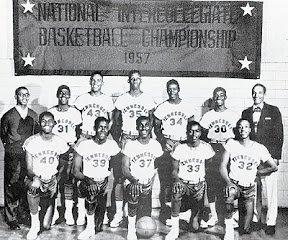
         Tokenism in Hollywood and other mainstream cultural outlets provides an excellent cover for those who would carry the banner of racism and sexism. It is not to suggest that African-Americans should not continue to seek out such positive roles. It is not even to suggest  that  filmmakers, producers, and directors should not intentionally seek to place African-Americans and other minority groups in non-traditional roles and settings (such as not making all terrorists Arab). But to claim that the presence of such roles legitimizes those who would claim in turn that Americans are in fact comfortable with such possibilities and therefore if Senator Obama or any other minority candidate in the future fails to be elected then it is due to the politics of the candidate and not his skin color is a dangerous and slippery proposition. This palatability proposition allows genuinely racist forces to flourish underneath this level of political discourse. This proposition essentially acts as an automatic disqualification for anyone who would seek to "play the race card," even in situations where race is still an issue, and I claim that race in the US in 2008 is still very much an issue. The truly disconcerting element about this latest form of tokenism is the ease by which it is being propagated and manifested. Amazingly, the token examples are being pulled not out of real life, but out of a movie or television show, scripted ones at that (I know, scripted TV still exists, incredible). At least in  sports there were Tennessee State, Texas Western, and Jackie Robinson, and at least in the military there were the Tuskegee Airmen. Here there is only a simulacra of a token, a simulation of a Black President. It is patronizing at its most duplicitous to offer movie characters as examples of a legitimate indicator of public sentiment or as a tangible shift in the racial and political landscape of this country. 
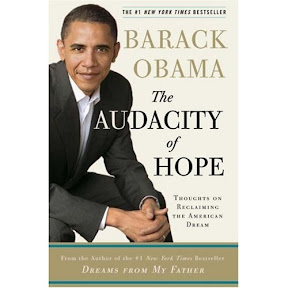
      At its most benign I see this sort of reference as an attempt to placate the suspicions that we as a country are still torn and afflicted by race related issues. As if the soothing baritone voice of David Palmer will comfort our fears that this country is still racked by racism. It is a bedtime story to lull us into a false consciousness about the existence of the color barrier. The tragedies and travesties of Hurricane Katrina in New Orleans not the least of which were man-made exposed this raw, festering wound and made us all aware of another so-called inconvenient truth. This one however can be easily triaged. That triage comes in the form of the now three year Junior Senator from Illinois Barack Obama. Though Obama first gained the spotlight at the 2004 Democratic National Convention, where his keynote speech electrified the audience and pundits suggested that his "audacity of hope" rhetoric might position him well in the future; it is the Katrina Disaster which gave him the political pretext to run in 2008, or more accurately gave him the political credentials to be a viable candidate since actual credentials are somewhat lacking. There is a sort of insidiousness in my implication I realize, somehow Obama is a tool of the political elite which has given him the green light to run in order to conceal the black and white divisions that segregate this country as severely as the red and blue ones. But nothing suggests to me more that Obama's Blackness is the key and the center of our four-color political theory than the fact that his middle name is Hussein, his father was raised as a Muslim in Kenya (though his book suggests that he was a confirmed atheist at the time of meeting Obama's mother, whatever that means), that he grew up in a secular family and the one thing people really talk about is his race. With the rise of Islamophopia in the West and the standing Beltway aversion to public confessions of atheism the thought that Obama's race would be the big issue suggests either that the Obama spin machine has done an excellent job of downplaying these facts or indeed the one thing he cannot hide is the one thing America cannot get over. For the time being as long as there are candidates who happen to be black there will be Black Candidates.

On the day of the Superbowl, it seems appropriate that I mention the infamous question  apocryphally asked of  Doug Williams, "How long have you been a black quarterback?" As it turns out the winning signal caller of Superbowl XXII in 1988 misheard the question. However, it is this sort of appellation "black quarterback," which continues to haunt our linguistic landscape and such damages constructive and helpful political discussion. Interestingly enough, this Superbowl came on the heels of a media debacle for CBS when 15 days earlier Jimmy the Greek made some controversial statements about how the dominance of black athletes was due to their breeding during the period of slavery. He was quickly fired for those comments, and the first black quarterback to win the Superbowl went on to beat the Broncos 42-10. Currently, the big fight in the NFL and the NCAA is to have more black coaches and assistant coaches, incidentally Doug Williams was the head coach at Grambling State from 1998-2002. He took over after the legendary Eddie Robinson who recently passed in 2007. Today there is less talk about Black quarterbacks, the current quarterbacks who happen to be black have suggested recently that they receive somewhat harsher criticism than their white counterparts. Some of those complaints might be legitimate, some of it might just be a  little oversensitive considering the drubbing that Eli Manning had taken in the New York press until his epic run in the postseason. While the Michael Vick situation did re-ignite some of those racial flames as some attempted to exculpate Vick on the grounds that dog-fighting is a Southern thing, or some other code word, many quarterbacks in the NFL and I would say almost all quarterbacks in NCAA enjoy racial anonymity. 

     Racial anonymity is not color-blindness. People who claim that they do not recognize color or race are really propagating a type of naive cosmopolitanism that ignores difference and is oblivious to the cognitive traits that humans must employ in order to make judgements on a routine basis. We must make handy stereotypes in order to function, it was built-in so that we can avoid dangerous situations.  This is discrimination,

but it is not one for which we are morally culpable. Yet racial anonymity is more of a linguistic ambivalence versus a cultural or racial blindness. As an example of this, consider the comic book (using that CYMK color printing model) sponosred by the Catholic Church the Treasure Chest of Fun and Fact, which was in publication from 1946-1972 and distributed to parochial schools all across the United States. In 1964, a series of issues (Vol. 19: 11-20) called "Pettigrew for President." The comic follows a family working for a candidate in the 1976 election. The series which ran from January to June of that year culminated at the National Convention. Throughout the comic we never see the face of Governor Timothy Pettigrew. At the end of the Convention when all the delegates are counted and Gov. Pettigrew is introduced and it is revealed that he is black. The last panel ends with poignant paragraph, suggesting that in 1976, the 200th anniversary of American Independence that it was possible and appropriate that an African-American candidate could gain the nomination of a major political party and have a chance to win.  Though they were at least 32 years off, and they did of course call Mr. Pettigrew the first "Negro" candidate, the Catholic Church was certainly progressive for its time. I think the message is not that a "Negro" candidate should in fact win the election or that there should be more Black candidates for President, but that what makes a good candidate is his or her ability to build consensus, establish a solid political platform and speak intelligently about the will of the people. We are not blind to his or her color or race, but it is only after the primary colors of our current political landscape, the red states, the blue ones, and our green attitude (constiuted by both the environment and money) that we should add into the mix black and white.

Monday, January 28, 2008

Common Sense Philosophy now Less Common, or Dancing Around Architecture

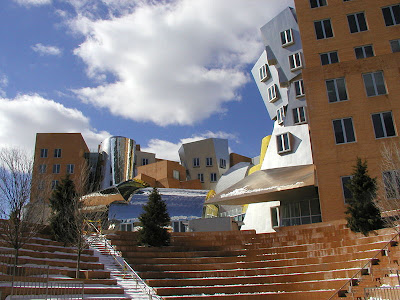
The building pictured to the right is the MIT Stata Center, which houses a couple of Computer Science and AI Laboratories, as well as the Linguistics and Philosophy departments. Designed by a Pritzker-Prize winner, the equivalent of a Nobel in the Architecture world, Frank Gehry is being sued for design and structural flaws. The building once described by Gehry as looking like a drunken robot party (I fail to understand why this would be a reasonable design concept, unless they were of course...girl robots), the flaws have caused such problems as mold appearing in the amphitheater due to a poor drainage system and some masonry cracking. The court papers also complain about sliding ice and snow. Sliding ice and snow, really, is this really a surprise to anyone? Look at the building, seriously, what did they expect in Cambridge? Gehry claims that it's a result of "value engineering," code for "the Luddite Philistines don't appreciate my genius," or more xenophobically, "cheap immigrant labor." The construction company responsible for the $300 million abortion claims innocence and no philosophy professors or other faculty who have offices there, including one, Noam Chomsky, have been injured yet. MIT administrators remain on the insurance hunt warpath, common sense warpath long stopped, sometime after the Scottish Enlightenment. 

The New York Times Tower designed by the 1998 winner of the Pritzker Prize, Renzo Piano, famous for his Georges Pompidou Center, is also suing the architecture firm responsible for this exposed ceramic roded cruciformed phallus. Apparently, ice forming around the rods heat slightly during the day, I know hard to believe, but this heating causes ice to fall from the sky at intense gravity accelerated, skull-damaging velocities. The structure of the building, with its glass facade has also led to two windows shattering and falling to the earth in the span of a week.  This so-called green-building with its reduced environmental footprint and energy-saving features (glass still remains sharp, however) is not without its merit, but they will have to do something about the death icicles.
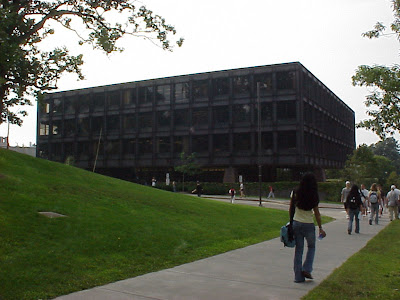
It is likely true that the amount of planning, testing, and redesigning that must go into these contemporary structures is mind-numbing and tedious at best.  It is also that tediousness, no doubt, which generates the massive price tags on those projects. However, it is equally interesting to encounter the cracks in the foundation (pun most definitely intended), as tiny design issues on paper become massive health and safety issues in life, and legal battles in court. Though these issues are nothing new; they are becoming more common as the desire for invention and creativity quickly outstrips the human capacity to foresee, schematize, and account for every contingency. The first such encounter for me and still one of the most head-shakingly amusing ones I have made note of is Uris Hall (pictured right), which is on the lovely campus of Cornell University in Ithaca, NY. Apparently two graduates back in the 70's from my dear Alma Mater far above Cayuga's waters decided, after making a ton of money, that they wanted to name a building after themselves, a natural impulse I guess if you are rich. In Pittsburgh they saw the U.S. Steel building, which was composed of  Cor-ten steel. This type of steel was particularly resistant to corrosion due to the fact that as the surface oxidized it would develop a brownish-orange patina that would protect the metal alloy. Both impressed by the material and the color its patina produced, they asked the material to be the principle component in the building of this academic facility. Unfortunately for them but fortunately for the students and inhabitants of Cornell and the surrounding town, the air in upstate New York does not contain the sulfuric pollutants that the residents of Western Pennsylvania inhale. As a result, good air, ugly as sin rust. The building is currently a sort of splotched dark brown and black cage-like monstrosity but is in no danger of corroding. In other news: Men more like rodents than previously suspected in detailed planning tasks says a report out of Scotland. As you may have noticed, Scotland has had a long tradition with both Common Sense and the best laid plans of others, I bet their buildings don't look like drunken robot orgies.
Sunday, January 27, 2008

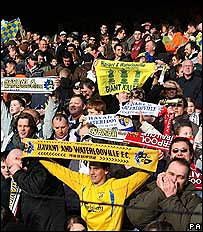
A Good Loss is Hard to Find or Havant & Waterlooville FC Revisited

 Liverpool 5 - Havant & Waterlooville FC 2. Despite the loss, those part-timers from Hampshire, a coastal county in the Southeast of England, did not come for a jolly-up they came to play and play they did. Taking the lead not once but twice in the first half to a side in which a deal to refinance the team was recently reached for a staggering £350 million.  Playing with resilience through the first half, it was only in the second half did it look like  they were actually playing a team of multi-million dollar earning professionals. While a disappointing game to the 6,000 Hawks fans that made it to Anfield, their team gave them much to cheer about and little to complain. After the game the Liverpool fans gave the team a standing ovation, earning perhaps the next best thing to a victorious result, respect. Though things will no doubt settle down in that coastal town, as the global attention fades; I am sure the players and fans will have much to talk about, including how to keep the website from crashing for the next time, and of course there will be a next time. 

Thursday, January 17, 2008

Heroes for the Night or Why You Must Love the FA Cup

In a great upset last night during a round 3 replay (that is rematch) of FA Cup action, which is a major soccer competition for the British Isles Havant & Waterlooville FC shocked Swansea in 4-2 banger of a game. What makes this upset notable, is that the Hawks are a number of leagues down the huge interconnected pyramid that is the U.K. Football system. There are literally thousands of soccer teams in this system most of which theoretically have a shot at winning the FA cup, though in reality only eight times has a non-premier league team won the whole thing in its 140 year history. To place the difference in supposed quality between the two teams in some perspective, Swansea play in Coca-Cola League One, in fact they sit atop the table, which is one league removed from the Barclay's Premier League, the one that features all your favorites: Manchester United, Chelsea, Liverpool, Arsenal and 16 other major soccer teams.  Havant & Waterlooville FC on the other hand play in the Blue Square Conference South division which is a number of leagues down the chain. This equates to about 83 places away. Most soccer systems around the world have a mechanism known as promotion-regulation, whereby a team that finishes at the top of their table, i.e. top of the league have the opportunity to play in the next higher league. By the same token a team near the bottom of their table, may lose their spot and be regulated to a lower league the next season. Havant & Waterlooville would have to be promoted 3 times to compete in the same league as Swansea. Three times! If they happened to be regulated out of their current table they would be in the Isthmian Premier League, the Isthmian Premier League! The game itself was pretty spectacular, 6 goals is a fairly high scoring affair. Moreover, as the announcers pointedly mentioned, that these guys Heroes for the Night, are probably going to have to call in to work in the morning, along with their reveling fan base.  In another example to elucidate the uncharted territory that this team now finds itself; the website that belongs to the Havant & Waterlooville team broke last night as so many people suddenly became interested in them. Their fourth round match is against the mighty Liverpool, yes that Premier League mainstay Liverpool, on January 26th. It is likely that this somewhat unlikely run will end at Anfield, but lest you think they aren't relishing the occasion to play, you can already purchase a T-shirt for the game which details their road to Liverpool. Moreover, the game will net a significant cash windfall for the team, somewhere on the order of £500,000. If the greatest upset in FA cup history were to occur and the Hawks manage to beat Liverpool, the closest analogy that is available in the United States is if a World Series of Baseball began with all the teams in the MLS plus the Entire Farm League system and the New York Yankees lost to the Tampa Yankees (a single A team). You really never know...but that's why you play the game! Go on Hawks!

Sunday, January 06, 2008

The "New" Mysterians...?

 In a recent article from the Guardian, Stuart Jeffries acquaints us with a delightfully rancorous professional squabble between two philosophers of mind, Colin McGinn and Ted Honderich. Though their personal drama is fairly salacious, some nonsense about ex-girlfriends and subsequent ad hominem invective, their philosophical disagreements are no less divisive. Colin McGinn along with public intellectuals such as Noam Chomsky and Thomas Nagel are proponents of a philosophical stance called the "New Mysterian" position. They suggest rather surprisingly that certain philosophical problems, like the one of consciousness are insoluble. There are varying degrees of insolubility, from: just currently not solvable all the way to a kind of a priori insolubility. The name of the position itself derives from a band called Question Mark and the Mysterians [pictured left with self-denigrating  possibly ironic road sign], whose most recognizable single is the lyrically uninspired but oddly creepy "96 Tears."  Just to follow the ontological suture to its origin, the band name itself is borrowed from a 1959 movie entitled, The Mysterians, which itself was originally a 1957 movie called, Chikyu Boeigun. [Tagline: They come from another World...They want 3 kilometers of land-and...FIVE of your WOMEN!] That's .6 kilometers per woman, frightening.

The central tenet of the new mysterian position holds that the problem of consciousness is either too complex or too "close" to be properly explicated. What is implied by "closeness" is that the degree to which we are imbedded in consciousness either as an individual or as a species restricts our ability to apply the analytical tools required in order to properly parse the phenomenon of consciousness. If this sounds more like an old mysterian position along the lines of a theological doctrine of omniscience and the impenetrability of the mind of God, you are likely not alone. Though it does not explicitly or even implicitly demand a manifested onto-theological structure; such a position is at worst amenable to such a concept. Moreover, those who claim this philosophical stance offer good reasons for believing that this is the case, rather than (as it might be assumed) claiming an epistemic weariness or a psychological unwillingness to go on. The mysterians allow that there is still good work to be done on this most-vexing of phenomena, but the bar of accomplishment must necessarily fall short of a complete solution to the problem of consciousness. The mysterian position as far as can be determined is rather in the minority of the academic world, and immediately a certain sort of repulsion arises at the notion that a lively philosophical position can be promulgated from the stance of necessary failure. One of the most compelling and engaging features of philosophical discourse is that it does not as a matter or course, close itself off to its horizons of possibility. Furthermore, there is a generally accepted and fortifying sense of acknowledgment of the  indefatigability of the human intellect, which serves as a basis of scientific endeavor.Scientists and philosophers are notorious for their singular obsession with what might be considered abstracta  or minutiae; it is that sort of commitment, which has yielded many discoveries about our world, and our experiences. Prima facie this so-called mysterian position seems to undermine that commitment at its very core.

There are those who would claim that there exists a Church of Science and of Philosophy, insofar that these institutions are dependent on certain axiomatic principles or beliefs which cannot be challenged, much like canonical church doctrine, except through major revolutionary processes or "paradigm shifts." If indeed these cathedrals of the intellect do exist, surely we must count these "mysterians" as their most dangerous heretics. [They have come to invade the earth, abduct its women, and level the basic suppositions of a mechanistic observable universe] They are perhaps even more dangerous than those who would carry the banner of "intelligent design." All they want (though, it is admittedly far too much) is to have their books included in the liturgy and set alongside On the Origin of Species. These mysterians would have us believe that science/philosophy does not and cannot have all the answers, that in fact, (ab)solution does not lie within that Church.  Yet, there is a residuum of inquiry that would seem heretofore contradictory to this ostensibly defeatist attitude. The mysterian position does compel its critic to wonder, at least minimally, if in reality there exists a "solution" to the problem of consciousness, how will we know we have found it? More fundamentally, what constitutes a solution to the problem of consciousness? In the typical hypothetico-inductive experimental method, either reproducibility or some other strict method of verification is required in order to establish sufficient confidence about a theory. Is it necessary in order for us to establish the authenticity of a theory of consciousness, must it provide a description sufficiently capable of reproducing the phenomenon? Will a definition of consciousness be able to properly account for every minute and variegated circumstance in which consciousness manifests itself?  From this perspective one might consider including the mysterian position in the "big tent" of Philosophy and Science, because like most other authentic or meaningful philosophical inquiries, what it leaves us with is much like what it starts us with, a....

Friday, October 26, 2007

Waiting for an Existential Stuffed Burrito

   On the way back from Planet Incubus we frequented one of the fine fast-food drive thru establishments that dot our cityscape and suburbia. While waiting in line, this kitty was waiting placidly in the cement expanse of the florescent brightened parking lot. Though the other passengers in the car were entranced by its ridiculous cuteness and we were all of course touched by the stark vulnerability of such a small kitty (note its size in relation to the thickness of the line) it stands to wonder, What is this kitty waiting for? Those of us in the drive-thru queue were clearly waiting to order 2000% of our daily sodium and an epic numbers of calories and yet this kitty, who can't read the menu and probably has enough sense to avoid the food if given the opportunity watched implacably the line of cars in the lot. Though I was still in medium orbit, it seemed clear to me that this kitten reflects a lot of our present situation (or perhaps my present situation) in the modern condition. I think this small creature is waiting for life, liberty, love and a chance. At least I hope it isn't waiting for an empanada. The most pressing question for me during this encounter is why is this kitty not afraid, bright lights, large loud exhaust producing vehicles any number of anti-kitty tires were just feet away from its position and there it waits. In art, animals, especially cats and dogs are often included to bring home a point, or to ask a question of the viewers, to represent some quality of the scene that might otherwise be overlooked, like the dog in Van Eyck's Arnolfini Wedding or the cat (that's no kitten) in Manet's Olympia. That night in the parking lot this kitten, its relative isolation was explicit and almost painful, was a jarring reminder, though I cannot presume that others could feel this way I by the same token cannot presume that at least some of those others do not feel this way.
Monday, July 30, 2007

The Lions of the Two Rivers

Yesterday, in a brief reprieve from the harsh realities of occupation, the Iraqi people celebrated victory as their national team, who were overwhelming underdogs, managed to beat Saudi Arabia 1-0 in a hotly contested Asia Cup finals, thus securing the first such championship for the "Lions of the Two Rivers." Though the traditional celebratory gunfire did result in a few unfortunate deaths and a handful of injuries, the warnings from government officials as well as the mosques did keep the accidental violence to a minimum. The well placed corner kick in the 71st minute, coupled with a critical error from the goalie, who horribly misjudged the trajectory of the ball, resulted in the only goal of the game. The header was beautifully executed by the captain Younis Mahmoud, a 24 year-old striker, who currently plays for Al-Gharafa, which is a Qatari League Team.  The performance of the National Team at the Asia Cup for the past few weeks had been well-monitored by the Iraqi populous eagerly anticipating Iraq's performance, with each successive victory leading to greater and more boisterous celebrations.

        A far cry from a few months ago when  in April mired in controversy, strife, and general frustration (I think for obvious reasons), the team hired Brazilian coach Jorvan Vieira. Only seven weeks prior to the start of the Asia Cup, Vieira a convert to Islam accepted the job after three previous candidates rejected the position after receiving death threats, his own assistant could not come to Baghdad because he received threats that his son would be kidnapped. However, Vieira, who has a doctorate from France in Sports Sciences and speaks seven languages, galvanized his team and had them prepare for the Asia Cup in Amman, Jordan. The team is made up of all three major religious and ethic groups in Iraq: Shi'ite, Sunni and Kurds, and he managed to unite them under his calm and professional leadership. Vieira is no stranger to coaching in the Middle East, he assisted Jose Faria and led a plucky Morocco to its second World Cup in 1986.  While at Mexico '86, they became the first African team to win their group and advance to the second round, a group which included England, Portugal and Poland losing a close second round match to the eventual runner-up West Germany.

       The 54 year-old Vieira has coached a number of club and U20 national teams in the Middle East, and despite cobbling barely enough players (six) just six weeks prior to the Asia cup to start a training session, his real work has been in attempting to unify the hearts and minds of his players. Watching the on-the-pitch celebration, the lines between Sunni, Shia, Kurdish were blurred by tears of joy and disbelief.  A dream run if there was ever one, undefeated and only conceding 2 goals during play, the Iraqis also handed pre-tournament favorite, the Socceroos of Australia a stunning 3-1 defeat on their way to their first Asia Cup title.  

The post-tournament press conferences revealed the good work that Vieira and the rest of the Iraqi National Team staff have done in promoting team unity. Nashat Akram, a midfielder and man-of-the-match winner, proclaimed that this victory sent one message to the rest of the world, "The message is that there is only one Iraq, Iraq belongs to all its sects and all its people." Captain Mahmoud suggested less positively yet with the same nationalistic bravado that he wanted America out, "Today, tomorrow or the day after tomorrow." State television minutes after the victory reported that Nouri Al-Maliki, the recently much maligned and embattled Shi'a Prime Minister of Iraq, would reward each player with $10,000 dollars (Iraqi). Unfortunately, many of the players cannot return to collect that reward since some insurgents apparently do not like soccer and have threatened them or their family if they returned to the country. Also in a wise and prudent move, Vieira has announced that he would step down as head coach in a press conference after the victory, comments amusingly reminiscent  speech given by Bush on the USS Abraham Lincoln way back in 2003, "I have worked my best to give happiness to the Iraqi people, to bring a warm smile to their lips and my mission is accomplished."

One victory in Central Jakarta will not lead to lasting unity, but as a general believer in the salvific power of sport; it is nice to know that the Iraqi people for the past month have had something to distract them, and that something, for once, didn't let them down.

Friday, July 27, 2007

Everybody Panic, possibly!

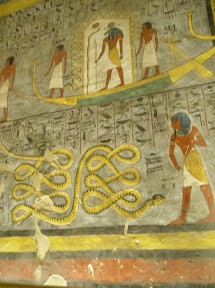
 Standing on the dance floor surrounded by the din of the Wednesday night bar crowd and staring blankly into spaces unfamiliar and faces unreachable, I noticed that Late Night with Conan O'Brien was on. His guest that evening was Neil de Grasse Tyson. The latest in a string of physicists to explain all things cosmic, his apparent street credentials garnered him an audience with the august Mr. O'Brien. Mr. Tyson, one of Time Magazine's 100 most influential people. He was discussing among other things a relatively significantly sized asteroid that has a pretty good chance (pretty good as far as the mind-boggling expanses of deep space allow) of striking the Earth. Originally calculations had the 1000ft diameter traveler striking in 2029, further refinements now suggest that the close fly-by to Earth (so close that it should make a bit of show as it streaks by), specifically Earth's gravitational pull, will alter the trajectory of Apophis in such a way as to set up a possible collision 7 years later on April 13th, 2036 to be exact. Apophis is a Hellenization of the name of the Egyptian Demon Apep.  A water snake (pictured left, taken from a Temple in Luxor) he will be slayed by Ra.  This of course nicely predetermines the name of the ship/mission that will be sent up there to destroy the asteroid in case the calculations turn out to not to be in our favor. The movie that results should be great, "Armageddon II: Ra Ascending," Bruce Willis' cryogenically frozen body will be reanimated just in time for the sequel and when he is done he can begin work on "Die Hard 14: Please Just Die."   The mythological references aside, Tyson informed Conan that "top people were working on this" (pause for sarcasm). The chances of this rocky formation slamming into our dear planet is somewhere around 1/5000 to 1/45000. These are not necessarily overwhelmingly dire odds, but nevertheless some at NASA are concerned, and have begun to develop response strategies in order to potentially avoid disaster. The other factor in Earth's favor (one of the few things that are her favor these days) is that the size of the asteroid  will not cause catastrophic damage to the entire planet; however, scientists predict if it were to strike, significant local or regional damage would occur. With all the asteroids and meteors and other NEOs (Near-Earth Objects) how was this possibly threatening one discovered. The Spaceguard Survey since 1998 has been devoted to discovery, tracking and assessment of these objects. The graph to the right shows the orbits of the terrestrial planets along with the orbits of the 100 nearest-to-Earth objects. The Spaceguard, which took its name from a similarly tasked research body in the Arthur C. Clarke novel, Rendezvous with Rama, has quite a lot to look after with a modest budget of approximately $3.5 million per year. Reading the white-paper on this research body is a bit of a jarring experience, considering the catastrophic consequences that abound in between the lines. For example consider this snappy line from the Spaceguard's documentation:


Indeed, during our lifetime, there is a small but non-zero chance (very roughly 1 in 10,000) that the Earth will be struck by an object large enough to destroy food crops on a global scale and possibly end civilization as we know it (Shoemaker and others 1990).

"Small but non-zero chance." Comforting, eh? If one becomes concerned about everything in the universe of which there is a small but non-zero chance of occurring then perhaps one would soon be committed to a mental institution suffering from an extreme case of depression and/or paranoia. Nevertheless, I am bemused by the fact that we are surrounded at all levels: locally, nationally, globally, and cosmically by threats and perceived threats (both true and false) to our existence, and despite our occasional complaints about an unnecessary cultivation of fear in our society prompted by our media and our administrations, we are often ignorantly quiescent to many of the less publicized but nonetheless possibly cataclysmic imperilments that we face on a daily basis. More entertaining is that there are people whose job, on a daily basis, is to analyze and consider these imperilments (I am sure many of whom are inside the Beltway) with all the perfunctory flourish of a mailroom attendant.  I imagine water-cooler conversations must have a hint of an additional gravitas or maybe they still talk about how much the Redskins need help. Though the sky is not falling, and the bad men aren't always knocking at our door I wonder how much we'd care if we knew they were. Generally, I feel that it is dangers such as this, though not particularly asteroids crashing into Earth, that really are worth fretting over, and many of the so-called dangers to society that are hyped up in the media or by government officials are the things that are the least doom-spelling. The incurious attitude adopted by so many finds me standing in a bar disappointingly alone in my thoughts, looking intently at the TV screen, wondering if I looked hard enough or stood still enough someone else would notice.

Wednesday, July 25, 2007

Hyperbole Shrugged

      On December 6th, 2006 Norman Borlaug won the Congressional Gold Medal. The Congressional Gold Medal is the legislative equivalent to the Presidential Medal of Freedom and not to be confused with the Congressional Medal of Honor which is a military distinction. Most, if they were asked to name the only two living American-born Nobel Peace Prize Winners, the name of Norman Borlaug would be slow to follow the honorable Jimmy Carter (those who might suggest that Kissinger is still alive must remember that he was born in Germany, although with that deep guttural tone which smacks of authoritarianism, how could you forget). Norman Borlaug has been called many things: a father of the Green Revolution, Greatest Living American and perhaps if you are a fan of the television show "Penn & Teller: Bullshit!" you will recognize the title the "Greatest Human Being Ever." It has been estimated that this man has saved close to a billion lives. His primary contribution to the world has focused around developing new techniques to increase the world food supply. His research has led to high-yield, disease-resistant wheat and other essential agricultural crops. Still very active and sharp at the ripe age of 93, giving his well-delivered acceptance speech without notes; it is inspiring to read about his single-minded commitment to augmenting the world's food stores, a commitment that has garnered some negative criticism due to the input-intensive nature of his farming techniques as well as his development of cross-breeding and genetic engineering techniques, which have been claimed to be unnatural or damaging to the environment. Mr. Borlaug despite his numerous appellations continues his important work as an advocate of responsible and effective world food supply management. If you are interested there is an excellent biography, The Man Who Fed the World (Durban, $25) by Leon Hesser, with a foreword by the other currently living American Nobel Peace Prize winner former President Carter.

     The competition for the honorific  "Greatest Living American" is not a one horse-race, in fact, according to Google, it is none other than Mr. Stephen Colbert. Through a grassroots Google Bombing campaign he has managed to earn this well-deserved title.  In a further attempt to alter the public discourse, Colbert has suggested that the phrase "Giant Brass Balls" be the most popular searched phrase. Though Colbert's character in the show is a self-aggrandizing, cartoonishly conservative flagophile; his efforts have been warmly accepted by the young, and by the confused and generally awkward glances from the audience coupled with icy stares from the First Lady he received at White House Correspondence Association  Dinner on April 29th, 2006, general derision from the established (read: old) media outlets and the current administration. His latest attempt at shameful self-promotion (let us be clear that it is us who should be ashamed or so I think the unconventional wisdom would suggest) is a book to be released on October 9th, 2007 called humorously enough I Am America (And So Can You!) (Grand Central, $27). Apparently, it has already received the Stephen Colbert Award for Literary Excellence, so it is sure to be a page-turning read or if I were channeling Michio Kakutani, the enigmatic New York Times reviewer who will probably get her hands on an errantly released copy of this work as well,  "Colbert's limber voice seamlessly shifts between high satire and low digs at the tabloidized media, the evasive administration and the knee-jerkable public, a riotous romp through America's political and cultural landscape."

     That particular dinner speech was hilariously funny and unbelievably audacious, his calm and collected demeanor in an increasingly antagonistic crowd speaks to his talent and composure. Some have impugned exceptional importance to it, Frank Rich specifically suggested that that speech was a "cultural primary" and labeled it the "defining moment" in the 2006 mid-term elections. Despite the minor coverage over the controversy engendered by Colbert's 16 minute vicious invective, its genuine popularity is a direct result of the masterful utilization of the Internet and the much bandied about Web 2.0. Colbert has done a magnificent job, better certainly than any of the candidates in the 2008 Presidential Election, if the feeble YouTube videos contrived by their respective campaigns is any indication, of monopolizing the bandwidth of the denizens of the Internet.  Perhaps in the "Colbert Report" introduction he could add "Puppet-Master" to his growing list of self-congratulatory sobriquets.

Perhaps not....

Colbert and other have capitalized on the American penchant for Hyperbole in their media diet. Despite its unhealthy side-effects (it is of course terribly deficient in informative vitamin rich content and it is mostly fluff), the public loves a good outrageous claim (see Mike Gravel/Ron Paul), regardless of its "truthiness." Though I do not claim to have some special epistemological access to the truth and all its treasures, nor do I suggest that I or anyone else can be completely oblivious to the social and cultural conditions which facilitate this sort of obsession for aggrandizement; it must strike some as odd, if not just interesting, the continued misguided prioritization of and focus on the major issues and people that exist in our society and around the world. Perhaps it is the fact that real problems require real solutions, and such solutions are usually  long, hard, complicated and boring. Those solutions involve standing a wheat-field in Mexico for hours for months on end taking measurements of soil pH, and seed growth. These solutions require committed focused individuals who can shrug away alarmism, elitism and baseless criticism, public notoriety and must have their feet on and ears to the ground, the right ground (not D.C. but Baghdad). These solutions require serious people. The irreverence displayed by such shows as the "Daily Show" and "Colbert Report" all too easily highlights the lack of seriousness often present in our politics and exhibited by our politicians, by seriousness it is important to recognize the distinction between it and drama. Drama is a cheap simulation for resoluteness and purposefulness. Drama is the all night debate staged by the Democrats on the situation in Iraq which took place last week. Seriousness and earnestness are the illustrated by the real sleepless nights that members of our armed services are faced with on a somewhat regular basis, the two should never be confused.  We must shrug off the seductive nature of hyperbole so that we may bear the burden of a sometimes harsh reality.

Borlaug 1 Colbert 0