Saturday, May 12, 2007

Pipe Dreams in Nietzsche's Playground or...


The Importance of Titles: Not a Treachery of Images

Other than the sentence you are currently reading, the most nuanced and detail-oriented task during the composition of this brief vignette was the creation of the title. Perhaps, it shows. Nietzsche understood the importance of a good title. Some of the most interesting titles, subtitles, and alternate titles of academic works from that era can be found in the corpus of Nietzsche. Just to highlight a few in case you are unconvinced:

"Twilight of the Idols, Or, How One Philosophizes With a Hammer"
"On the Use and Abuse of History for Life"
"Thus Spake Zarathustra: A Book for All and None"

These works, of course, are more and less than what they offer. Titles are the dynamos of expectation. The efficiency of this mechanism depends on the cleverness, complexity, or the ability to communicate provocatively the contents within. As such, the title is the ultimate prostitute of the written language. It demands our attention, we are drawn to it by its superficialities, its pretty wares and its suggestive offerings. Upon purchase...the more glamorous the title, the greater the disappointment. It is not because the work within to which the title refers, cannot live up to its billing, and it is of course the case that the work gives us much of what we pay for, and can offer things no title could offer; it is simply that the title in all its exquisite formation is just that, an exquisite formation. It exists only for itself, only to perpetuate its own remembrance and repetition in the hearts and minds of book-shoppers.

The first sentence in the work, in contradistinction to the title, is beholden to the second, the third and the rest of the book. It must serve as fertile ground to give voice to the thoughts of the author and the explanatory foundation for the reader. The title is simply that which grounds the purchaser to give "voice" to her wallet. In many cases, the first sentence of a work is as memorable as the title of it, "It was the best of times it was the worst of times," and "It is a truth universally acknowledged that a single man in possession of large fortune must be in want of a wife." Dickens and Austen certainly had some appreciation for the importance of first lines, and not just for titles, but for characters and places as well.

Who can forget Mr. Wackford Squeers that less than lovable one-eyed Yorkshire schoolmaster from that alliteratively named Dickens work, Nicholas Nickleby?

Some first sentences try too hard, they are envious of their titular counterparts and seek to establish expectations of such momentous proportions that they fall miserably into a grammatically elusive, metaphorically overloaded and syntactically fucked abyss (See current sentence for evidence). Where do bad opening lines go, excluding the neighborhood pub, they go to the nomination bin for the
Bulwer-Lytton Award for worst opening line of a previously unpublished novel. Edward Bulwer-Lytton was actually quite an accomplished author, though he may not have written any literary tour-de-forces, he certainly had talent as a writer and is the attributed coiner of the interesting phrase, "the pen is mightier than the sword." His more critically successful novels included, Rienzi and The Last Days of Pompeii. However, the reason that this illustrious prize is named after him is that the novel, Paul Clifford, begins with the oft Snoopy-snatched intro:

"It was a dark and stormy night; the rain fell in torrents--except at occasional intervals, when it was checked by a violent gust of wind which swept up the streets (for it is in London that our scene lies), rattling along the housetops, and fiercely agitating the scanty flame of the lamps that struggled against the darkness."
Before we get into why, if indeed this opening sentence is bad, the train wreck that is the 2006 winner goes something like this:
"Detective Bart Lasiter was in his office studying the light from his one small window falling on his super burrito when the door swung open to reveal a woman whose body said you've had your last burrito for a while, whose face said angels did exist, and whose eyes said she could make you dig your own grave and lick the shovel clean."
This piece of work was submitted by Jim Guigli. Now it seems that there are some who are actively involved in trying to win this award given year by the San Jose St. English Department. I think that is cheating, it is the unwitting naiveness of the author in his or her fiasco of an opener which generates a truly robust experience of Schadenfreude, the sort of experience that I would argue, this award is meant to make emblematic . In any event, it is pretty bad, and for some unambiguous reasons. One, the super burrito adds a cheese factor (my apologies) that is most definitely intentional. Second, is it the light or the window that is falling on the super burrito, which is filled with gravitas and extra beans? Third, and really-who knew that body parts would have such a mediocre grasp of the English language and the grammatical categories of person, voice, or tense. Finally, that grave site must be fairly muddy to be licking shovels clean, and frankly I don't think I would find any pair of eyes compelling me to lick a muddy shovel to be particularly sexy or desirable.

In the first sentence by Mr. Bulwer-Lytton, the torrential downpour's punch is awkwardly attenuated at occasional intervals. While the violent gust of wind seems to be doing double duty as a janitor, and in case there was just too much going on, i.e. rain and wind (the oddly placed parentheses are utilized to help reveal an essential piece of the puzzle, that scenes lie in London...those bastards), and apparently Bulwer-Lytton believes scanty flames are easily angered.

We expect a lot from our titles, and from our opening sentences. We also expect quite a bit from our final sentences as well. Some great ones, and we must rely on Dickens here again, have included:

"It is a far far better thing that I do, than I have ever done, it is a far far better rest that I go to than I have ever known."-
A Tale of Two Cities

and this one from Kurt Vonnegut Jr.:

"One bird said to Billy Pilgrim, 'Poo-tee-tweet?''"- Slaughterhouse-Five; or, The Children's Crusade: A Duty-Dance with Death

Quite an evocative title as well, no? I think this sort of emphasis on titles, and on opening and closing lines is a result of the obsession of surface, and the tyranny of substance-ontology. We expect greatness to have measure, extension, weight...when we look at a box, a gift let's say, we recognize the "giftness" of the gift by enjoying its pretty wrapping, weighing it in our hands, and many turn the gift around in their hands to see all sides of it (a strange artifact of gift exchange indeed, this sort of anticipatory foreplay). Are they making sure it has a bottom, is the left-side going to be so radically different from the right side, that one must make sure the other side is not an elephant? It seems that this kind of objectification is exactly the sort of process that we apply to books. Now, books are objects, paper or vellum (okay..vellum not so much), that are bound together and covered. But there is also an objectification of the narrative, or meaning of the work. The sort of literary equivalents of wrapping paper, top and bottom seem to be these qualities of a work which have been discussed. I am not so sure this is how we should conceive of works of literature.

Hamlet
is not just the words Shakespeare wrote down that are contained in a Folio somewhere in some museum in Stratford-upon-Avon. Hamlet is an unfolding event of performances, readings, movies, critical interpretations that each have a historically traceable "flow." Hamlet, his character, represents a different part of a radically different society, than it did in 16th and 17th century Britain. The opening and closing lines of Hamlet are: "Who's there?" and "Go, bid the soldiers shoot." Ironically, despite the richness of the plot, character development, the famous "To be or not to be?" it is the first line "Who's there?" captures a great deal of the work's meaning and importance. Or so a typical critical interpretation might begin. Yes, the existential dilemma of Hamlet, the lack of closure present in most of the relationships, all figure as important themes in the work that may or may not be captured by the line, 'Who's there?" But, that is not enough.

Titles, emblems, one-liners only flatten and make surface-like the richness and complexity of language, which itself is already a flattening process. It seems that those who are interested in the project of humanity, should seek to deepen and exteriorize the deep play of their being human. Instead, we have a flattening of language, a reduction of diversity in our speech and writing habits..BTW this type of "new speak" is quite disconcerting and IMHO this should not lead one to LOL. The emphasis on efficiency, simplicity, and pattern is a language-game in which there are no winners. I believe if Postmodernism has any salvific attributes it is a deconstruction of these calls to efficiency and simplicity and the reinvigoration of the love of confusion, and paradox which might lead us back from scientistic Barbarism. Taking play seriously does not mean seriousness is a toy it can be a tool as well.

Play, faith and style...

Friday, September 22, 2006

7' 9 1/4''


The distance that titles this post is the official distance between the "ockey" or toeline as it is more generally called and a dartboard on the wall. 68 inches is the height said dartboard should be on that wall.

Why?

When I first heard this distance it struck me as really and frustratingly unusual. This distance isn't easy to measure, it certainly isn't a round number, and there is no reason a priori
that it should be set at this distance. I cannot imagine that if the dartboard was 7' 10'' that suddenly the game would become impossible, or crazier still that at 7' 9'' the act of throwing darts would become child's play. And yet here we are in North America locked into this distance, if we wish to maintain legitimacy in our dart-throwing exploits. Of course in the rest of the world the distance is a no less stifling 2.37 meteres. Which really isn't any better other than the fact that it is slightly easier to type.

In a seemingly unrelated revelation, on the way to a restaurant, Thai to be exact, in Channelside we were walking through a zone of significant construction. The slightly unsettling process of gentrification was wholly evident as multiple high-rise condominiums were being built simultaneously. Walking through this zone a colleague and friend commented that his summer job gave him new insight into the all the various spray-painted lines that were marking the ground in all their multi-colored glory. He informed the group that each color line represented a various utility such as electricity, water or sewer - and he could also tell something of how much of each utility was needed based on the positioning and length.

In a third incident, I purchased a couch off craigslist, I was eager to acquire this couch because of its relative pristine condition, color and low low price. Of course, after picking up the couch from this very nice young couple who were busy moving into an ostensibly smaller home; it occurred to me that this couch even though its lovely green and red plaid design was quite alluring that it may not fit at all underneath my lofted bed. As I drew closer to home this fear multiplied and realized that I would have invested a great deal of time and effort in interiorly designing my room such that I could have this couch in this place and in the final calculation it would not work. After unloading the couch and bringing it into the room the moment of truth had arrived. Much to my pleasant surprise the couch fit. I cannot emphasize how perfectly this couch fits. A centimeter longer and I would have been screwed entirely.

The connection, between a dartboard distance, a spray-painted sidewalk marking, and a fortuitously fitting couch-codes and a deep structure of conformity. In retrospect I had no business believing that this random couch I bought off the Internet would just magically fit underneath my bed. The more I think about it, the more ridiculous my reasoning behind the purchase was. I had earlier found another couch that was a bit shorter and decided that it looked a bit off and decided to look for another. The eventual couch I purchased certainly looked longer and I decided based on one badly taken picture scanned into an ad, which gave no real perspective on the size, even though it was longer it wasn't "too long." Yet it did fit, and fit like a glove I tell you.

Why?

Because part and parcel with a socially constructed world is a physically constructed world in which couches are made to certain lengths that match the length of lofted beds. That the lines on the cement are invisible to most, and by invisible I mean something like irrelevant, and yet those who have access to the codes like my friend are able to decipher a richly descriptive narrative of the construction zone. And yet like the distance between a toeline and a dartboard these numbers, the numbers and symbols involved are totally arbitrary. I am positive at some point that at some bar someone decided to place some type of proto-dartboard on a wall and decided to draw a line so everyone would throw from the same place and figured that the distance wouldn't get in the way of his servers, bartenders or patrons walking around, and still make the game interesting enough, then a rival establishment decided that they wanted to have this new and fun game as well, copied the distance and height, and voile...the absolutely random distance of 7 feet 9 and quarter inches becomes the standard for all time. I am also equally self-assured that some home furnishing expert could inform me that couches and beds are made to preset lengths and there is a complicated set of rules that decides what these lengths are. However, not having access to this deep structure I am given to this sort of mystical bewilderment and sense of enchanted wonder when a random couch I find online magically fits under my bed. I am left to wonder how many code systems daily affect me without the slightest cognizance of it all happening and how I am constantly at the mercy of this structure to conform.

I have considered to some degree that this all has been brought to my attention through a number of my recent purchases. Self-admittedly in recent weeks I have gone on a sort of spending spree, and I wonder if the less one submits to consumer culture one is less likely to be exposed to these deep conformity structures. Moreover, to the degree that one submits to this culture of conspicuous consumption is to the degree one is controlled by these structures. I find that since I have invested in particular electronic equipment, which previously I had never allowed myself to invest in, that I spend more time looking at advertisements for similar and of course superior products, which engenders the desired result of jealously and desire. This feedback loop further pushes me deeper into the grasp of the deep structures of conformity, destined to further invest in toys that I do not need in order to make the toys I already own more functional...and of course there is a cable for everything.

Saturday, September 02, 2006

Philosophy in the Time of Zizek!

and a one and a two....

Slavoj Zizek, (now with exclamation mark) Slovenian intellectual (rolls off the tongue, right?), so-called "wild man of theory," and rock-star of the academic circuit. His work, if you dare, can be exceptionally rewarding not because of his ability to sustain a Lacanian-Marxist critique of post-9/11 cultural politics, or dazzle us with a theological reconstruction of an economy of sign in a "post-secular" world, in fact it might be the case that his philosophical rigor is that which is most lacking. If you are to be rewarded it is in recognizing his whimsical, adolescent approach to a philosophical discourse dominated by very serious adults. The term 'adolescent' is not meant to imply that his work is simplistic, unfocused, or unsophisticated. Quite the contrary, his work is on the "bleeding edge" of cultural analysis-what is adolescent is his zeal and his commitment to bring philosophy out of the narrow halls of the ivory tower into the bright public light and to have it experienced as a public project. Let me quickly add that his work is not directed towards "the common man or woman" one must bring to the table a prodigious vocabulary, a deep and roaming knowledge of the history of philosophical inquiry, which can be made present-at-hand and a stomach for postmodern psychoanalytic jargon and analytical strategies.

Also, he watches a lot of movies.

The latest non-traditional step into the limelight is a documentary created by one of his students/admirers/lovers called
Zizek! In this movie (which is next on my Netflix Queue), we are introduced to the personality of this eminent Slovenian philosopher as he gallivants around the globe giving lectures, dropping knowledge, and leaving swooning twenty-somethings longing to be filled with hot neo-Lacanian analysis. No doubt with sexy results. I am intrigued by this phenomena of Zizek, not because I find his philosophical oeuvre entirely palatable or am I eager to debunk/invalidate his claims (the few he actually makes from time to time), but this notion of popular intellectual is one that I find life-affirming. It is comforting to believe, though I recognize the tenuous nature of this belief, that an individual can be valorized for his scholarship (despite its unorthodoxy) in a public sphere that slavishly fawns over such items as: glamour, physical titillation, raucous ridiculous behavior and obscenely envelope-pushing spectacles.

[Kool-Aid action="drink"]
That Somehow the media and the world are not so intellectually bereft and so evidently juvenile Zizek! can be experienced in a world where Jackass 2 can be "filmed", and shown in public to audiences for money!

That the economy of culture does not always find room at the bottom to consistently underwhelm.
[/Kool-Aid]

Unfortunately, I was watching the MTV VMAs last night, and in a moment of head-shaking consternation that only comes with an arrogant and elitist self-appraisal of one's own acumen and cultural literacy, I heard 50 Cent claim, in all seriousness, (or at least serious as he is likely to be in that situation) that the nominees for a particular award come from such diverse places as Michigan and Detroit. Now perhaps it is possible that "Fiddy" (that's what the kids are calling him these days) is making a subtle and insightful political comment about the cultural, and social differance between the state of Michigan and the city of Detroit and thereby implying a political distance if not a geographic one (alright...such a comment even if meant in this way is at best marginally insightful and mostly cliche), but I doubt it.

Is Zizek! necessarily a better option for society than MTV, no I will not openly and unreflectively submit to such a conclusion, though perhaps in my heart of hearts I think this is the case, but I am only glad that such options still exist, even if it is mediated through this ethos of the rock-star academic as the only type of academic which gains legitimacy in "celebreality."

Friday, August 25, 2006

European Anti-Plutonian sentiment rising, this time it's personal


At the 26th General Assembly meeting of the International Astronomical Union currently being held in Prague, which is known for its defenestrations and whimsy, Resolutions 5A, 6A, 6B were discussed and voted on to redefine what it means to be a planet. Arrogant Bastards. Contentious debate raged over terms like local population and Trans-Neputian objects, the number of planets vacillated between 12, 10, 8, and of course the traditional (and correct) 9. When the dust had settled the reclassification of such Local Group minutia as planets, asteroids, dwarf planets, and Small Solar System Bodies had left all in the meeting battered and broken, while leaving us on this side of the Atlantic mostly confused and a bit miffed. In their infinite "wisdom", Pluto is no longer a planet but a dwarf planet. This development can only be seen as a gross act of jingoistic exuberance by the EU against the United States of America.

I blame France.

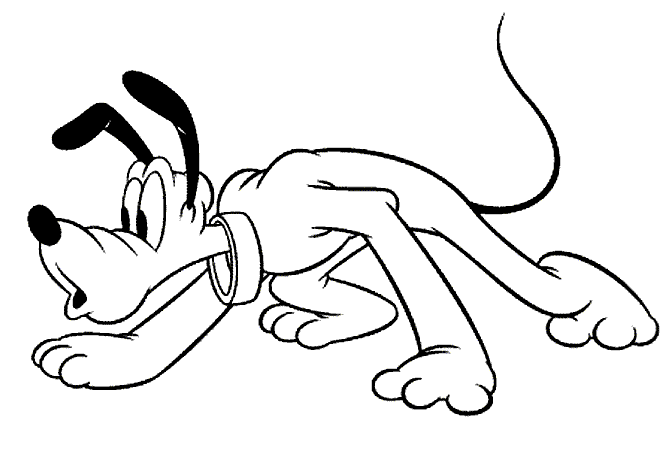
Apparently, they are still a bit peeved about EuroDisney™ and though they may be justified in their criticism; this astronomical interdict decreed by a kangaroo court of a scientific body is unrepentant planetism, and quite frankly it is un-American. Does that face look like the face of a "dwarf" planet? No, my dear reader, it is not. Pluto© is a testament to the creative genius of Walt Disney, though there is a strange ambivalence, almost a willful negligence when it comes to Goofy©. But more to the point, the issue before us is nothing less than a matter of nationalistic autonomy. Should we allow a bunch of Eurogeeks tell us what is and what is not a planet? The answer again is an obnoxious and Bud-soaked, never. If we allow this planetary
3/5ths Compromise to go on, it will only be a matter of time before we are all eating Nutella on Melba Toast, getting pumped for Red Bull's Flugtag and air-guitar competitions, and erratically switching between policies of multicultural co-habitation and forced integration as regards our minority religious and cultural populations. I urge all of you to contact your representative and demand that Pluto's right to exist as a full and participating member of the Solar System be vigilantly sought after. This is the exactly the sort of issue that can galvanize a nation during the midterm elections.

A Vote Against Pluto is a Vote Against America.

Sunday, August 13, 2006

Interrogating the Diet Pepsi...

Claude Frédéric Bastiat was a French liberal economist of the early 19th century, he is probably best known for the "Broken Window Fallacy." Essentially he constructs a narrative in order to illustrate the point that there are opportunity costs that are often not immediately visible and as such it is necessary that good economists become aware of, in an anachronistically postmodern way...Ce qu'on voit et ce qu'on ne voit pas, "that which we can see and that which we don't." Economics, that most dismal of sciences as suggested by that most bearded of sages Thomas Carlyle, is often perceived as the science of revealing the mundane in the everyday in excruciatingly mathematical detail. However, Steven Leavitt, author of Freakonomics has taken Bastiat's rule to heart in his work and revealed in interesting and occasionally controversial ways what lies below the commonplace. This disclosure is often paradoxically liberating and annoyingly confusing.

Economic processes often seem mysteriously complex and more to the point their explanations make arbitrary, highly mediated, and totally surprising logical associations, much like the price of tea in China. But it is these very types of associations that exemplify the rather beautiful and staggering nature (perhaps even frightening) in which individuals are enmeshed in our swiftly flattening globe. Thomas Friedman documents this process fluidly if a bit colloquially in his latest work,
The World is Flat. It becomes apparent that what lies below the everyday is far from mundane, if what is meant by mundane is boring or unimportant. While it could be quickly added that the smooth and highly readable prose of Friedman and Leavitt belie a considerably more circuitous and numerically nuanced picture, the social and political ramifications of this work, the statistical data orgy that it is, are undeniably important.

A few weeks ago, I purchased a fridge-friendly twelve-pack, of Diet Pepsi for $2.49 plus tax. Diet Pepsi was initially produced in 1964 as a sugar-free variant of its carbonated cousin. Today it is a deliciously refreshing aspartamed concoction with zero calories and carbs. In the twelve pack I purchased, one of the cans, which otherwise resembled its 11 other friends, despite being sealed had much less than the requisite 12 oz. of the light and crisp goodness that I had come to expect. My original indignation at the absence of the carbonated beverage was replaced with a sense of surprise and confusion, how could this happen? It is not as if John Boy at the plant had had one too many Lowenbraus the night before at the Overtime Pub and was off his can-filling game the next day, leaving my container pathetically under-filled. This process had long been automated and I had thought, erroneously, perfected. Yet here in all its light blue aluminum glory it was, its existence mocking all that is holy about product dispersion technology.

Russell Roberts, a professor of economics at George Mason, and author of the economic romance novel, The Invisible Heart, wrote a brief article that read more like a love letter to the Pepsi plant, and waxed poetic as much an economist is liable to do about the marvelous vessel-filling techniques that Pepsi and presumably by extension Coca-Cola utilize. In his effusion of schoolgirl-like admiration of the invisible in the visible in the purchase of a can of Pepsi, he offers that despite the 1.5 billion cans a year that this massive plant will pump out (oddly sexual isn't it, this tone is much more his than mine I assure you), the chance of encountering a half-filled or God forbid unfilled can will be minimal "once-in-a-lifetime" as a result some type of gamma-ray/crystal sensor device which measures photon absorption rates of the can. Further he suggests that such a gargantuan plant requires only a skeleton staff of approximately 15 workers to maintain the behemoth operation on a daily basis.

But, the mostly empty can remains, its contradicting presence foregrounding the invisible, bringing it into the bright light of day...pressuring, questioning the invisible to reveal its worst truths. This can, this hermeneutic tear in the otherwise smooth narrative weave of Leavitt, Roberts, and Friedman, through which the usually dulled and cowed eyes of the consumer might be able peer into the chasm of the Bastiat's invisible and interrogate the plausibility structure, and lay bare the very "human" processes which populate this not so flat, and maybe not so Freakishly efficient space, perhaps?

Tuesday, August 01, 2006

Stay, Capricious Memory...


I am always intrigued as to how our memories get directed and misdirected constantly, often with little volitional control. Despite having heard that the Treaty of Nystadt ended the Great Northern War, which lasted from 1700-1721, multiple times in an environment favorable towards the reception and retention of such information, I have as yet not been able to absorb or recall this fact when it matters (such that it ever matters).
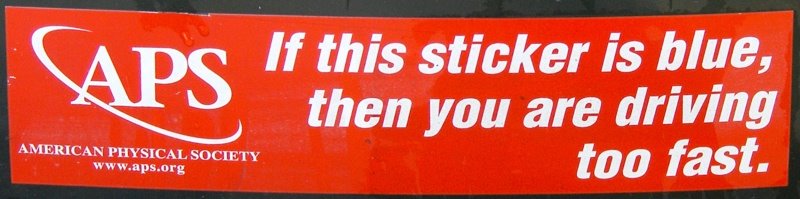
However, years ago while driving past the 300 block of Thurston Ave. in lovely Ithaca, NY -I saw this bumper sticker on the back of a car briefly before it made a left turn. Yet, this sticker and that morning I remember rather clearly, it was mid-morning it was late fall or early winter and it was sunny, which is rare itself in Ithaca at that time of the year. Why is this so? Often when I drive I am usually not fully aware or "plugged in" to my surroundings, especially if it is a route that I have taken many times, in such a case I am usually under automatic pilot. Yet, despite this brief encounter with this car sticker in what can be called an unreceptive state, this statement has been burned into my memory. I remember getting the joke almost instantly, if you are having trouble figuring out the allusion, it is a reference to
blue shift as predicted by the Doppler Effect. Nevertheless, it is amusing and yet incredibly frustrating that at times it seems that I have little willful control over what and how my mind works. My participation in certain intra/extramural events is the motivating force behind my obsessing over the process of memory, and I am always impressed by those whose vast powers recollection far exceeds mine. I am left perplexed at their ability, and inquire to the sources of their power. Is it just a matter of being religiously disciplined when it comes to preparation for an event? Or do they continually and in an omnipresent fashion walk around with this gargantuan knowledge base ready to "whip it out" so to speak on call? Those who are familiar and a bit cynical of this insular world of mine will definitely understand the phallocentric undertones (actually forget undertones, full on tones...it is painfully obvious to observe, and even more pathetic that I willingly and eagerly submit to this behavior) that permeate this subculture. From this side of epistemological gap it seems that their minds are virtual pulsating floods of information. Unfortunately, my memory does not speak to me in waves, but startles me with bursts which too often leaves me unprepared to cope strategically. It is my hope that one day I will be able to genuinely master the art of memorization, so that I may be able to file away information efficiently, and copiously such that it is available for immediate recall. There must be research out there that studies and attempts to account for these random acts of memory...but from this under-informed perspective it seems positively impenetrable. But I continue to struggle: Nystadt, Great Northern War, Nystadt Great Northern War....this works right?

Sunday, July 23, 2006

Carmen Electra and Hermeneutics, together again.

I recently discovered, that a work of Hans Georg-Gadamer, The Relevance of Beauty and Other Essays, was available at Amazon.com in English. I added this book to my wish list as it is my wont, and those who are familiar with this procedure know that the following page usually lists other books that readers who purchased this work also considered purchasing. I had expected the usual suspects, Truth and Method, The Beginning of Philosophy and maybe some Cambridge or Routledge Anthology, but much to my surprise according to Amazon.com-

Customers who bought The Relevance of the Beautiful and Other Essays also bought:

Carmen Electra's Advanced Aerobic Striptease


Carmen Electra's Fit to Strip


and of course...Carmen Electra's Aerobic Striptease


Now it seems that there are three possible conclusions that can be drawn from this:

1) Carmen Electra, the "talent" of these instant fitness classics is a student of philosophical hermeneutics
2) Gadamer fans are really lonely women who are overweight and have metal poles in their living rooms or lonely men who enjoy spandex, sweat, and repetitive counting to either three or 10 with their striptease.
3) amazon.com has far too many of these DVDs laying around and in a thinly veiled attempt to mass market them, odd juxtapositions have been created with sexy results.

I really, really hope it is 1)...

Thursday, July 06, 2006

Soul Brother...Alexander Pushkin


Alexander Pushkin famed Russian author of the verse novel, Eugene Onegin, among many other poems, short stores, and plays is apparently a Brotha. In fact quite proud of his African heritage, an unfinished novel, A Moor of Peter the Great is more or less a biography of his great-grandfather, Avram (Ibrahim) Gannibal. Though perhaps technically he is of Abyssinian and not Sub-Saharan decent, he is quite comfortable with the moniker "negry." Though I would imagine that the term itself "negry" must be understood in a radically different context than the term "black" or "African-American" is used in the United States today; it certainly might be useful to compare his self-understanding as an African and the modern Black experience. One notable point, the "hot African blood" that is often attributed to such other figures as the noble St. Augustine, he himself appropriates it as a driving force behind his many sexual conquests, which he alluded to in conversation and a poem regarding his heritage, "I please young beauty with the shameless frenzy of my desires." Though it seems he is not totally immune to the syndrome that W.E.B. DuBois intimated in his, Souls of Black Folk, the syndrome of double consciousness when he describes himself as "an idle rake, ugly descendant of Negroes, brought up in wild simplicity." It is of course the case that his enemies and rivals used his heritage against him, Faddei Bulgarin, apparently the Dan Savage of 19th century Russia describes Pushkin's ancestor not as "a Negro bought by a skipper for a bottle of rum."

An
article, by Anne Lounsbery in a 2000 edition of Transition Magazine is an excellent piece on the subject. She suggests that the blackness of Pushkin is not a minor biographical detail for American audiences, though to be honest it was a chance encounter with a question to which Pushkin was the answer did I become aware of this fact. Perhaps, I have been hiding under some type of literary rock and am apparently even more of a Philistine than I had previously imagined, but I guess that is for a later personal-inventory session. Nonetheless, I do believe that Pushkin's African-ness is not a well-known fact for those (and a dwindling "those" in United States) that even know who Pushkin is.

Russians, as I have been told by a number of sources, are uniquely aware of their literary tradition in a way many Americans are not so as it regards our tradition. Many a Russian, both of the literati and proletariat will tell you that Pushkin is the father of the Golden Age of Russian Literature, which naturally had a strong influence on the Silver Age of Russian Literature occurring soon thereafter. Some would suggest he is the single most important Russian literary figure, though I would add such a claim would be significantly more contentious than the former. I am not sure what difference Pushkin's "Negro Blood" makes if any in Russia, but I am left wondering as a last thought, if in the United States a literary figure of the stature of Pushkin could have ever existed or would have been recognized as the "father" of any age of American literature. The Harlem Renaissance is typically presented and conceived of as some brief and isolated outburst of literary genius, a towering mountain in an otherwise unaccented literary terrain. As the name suggests however, it had to be a "re-birth" of something and yet I am at a loss to offer another period in American History that provides a context from which to be reborn. Again, this might be some function of my gargantuan ignorance manifesting itself here in my inability to recognize other significant African-American authors before the 20th century and so further investigations await.

Wednesday, July 05, 2006

Of Red Cards and Fire Hazards: The Call of Coercion

This year's World Cup, which I have been watching quite avidly, has engendered a record number of yellow and red cards (at last count 27 red cards and 300+ yellow cards) blowing previous records out of the water, with three matches left to tally. FIFA has appropriately defended the referees, suggesting that the cards are given out in a concerted effort to clean up the game of Futbol. Most announcers, from the less than stellar ESPNcadre to the super-excited to be here Unavision crew, have thought the number of cards is ridiculous. In one match between Portugal and the Netherlands, a Russian referee dismissed 4 players and made 16 bookings...leaving a frayed and beleaguered match of 9-on-9 soccer. Let me add here briefly that 9-on-9 soccer is terribly unexciting, players have to cover far too much distance, far too often, leaving them and their passes in less than brilliant form. In the Italy vs. US match, 3 red cards and a number of yellows, turned a spirited and exciting match into a rather boring and defensively minded tilt ending in a 1-1 tie. Certainly there are those who will suggest, that many of the cards were legitimate, and that with some exceptions many of the cards handed out were justified. So this begs the question, has the game become too physical, and have players become too dirty, or too good at diving? Putting aside these contentious issues temporarily, there is another call of coercion which might help put this in perspective.

The new Fire Marshall in the State of Florida responsible for monitoring the safety standards of the buildings on this campus is apparently a card-carrying Nazi. In typical fashion, the University during the summer decides to unleash harsh and intolerable policies on the unsuspecting, though not entirely innocent Greek Life population. Last summer, it was the ridiculously illegal and inane, Amendment 1, which was to allow police officers to randomly walk around the private residences of Greek students. A number of letters to the school newspaper as well as some intervention from some external forces was able to put the kibosh on that University Initiative. However, the administration, a creative bunch, have decided to seek a higher, more uncompromising authority, the State. The State, which holds the bonds on the fraternity and sorority houses, has determined that despite 3 years of no fire issues, the houses are essentially cement encrusted tinder boxes, and someone must be held responsible. In Gestapo like form, the Fire marshals, replete with vague forms and even more vague explanations, stormed through and demanded that many of the lofts, composites, trophy cases and other "abominations to fire safety" be removed and/or taken down, leaving in their wake generally confused fraternity men even more confused and emotional sorority girls in utter shock as their charmingly designed and professionally decorated houses in a state of classroom-like sanitized banality. This is especially disconcerting for our lovely sisters of Greek Life as their houses are a strong selling point among potential new members. Regardless of the validity of such criteria, it is nevertheless the case that many sororities are a bit distraught with the prospect of recruitment, colloquially known as rush, precious few weeks away. What is the most disgusting and annoying feature of this new policy is the rather arbitrary and mean-spirited nature of the requests. Inflammatory letters intimating condemnation and eviction of premises, the terse and rude nature of the fire marshals, citing mysterious fire code violations as the source of our ills, and obscenely short time deadlines to rectify our most egregious errors. Unfortunately compliance is mandatory, and resistance is futile, Thank you, Hans vs. Louisiana

I sense a bit of resonance between these situations despite their radically different scopes. It seems that our reaction to the call to coersion is less a principled or analytically derived response but more an adverse response to new stimuli. The number of red and yellow cards are indeed quite high, but interestingly enough on a case by case basis most of the cards were legitimately handed out, or at least a reasonable defense could be garnered in its favor. It gains this edifice of ridiculousness when interspersed with a few really bad calls which colors all of the cards and dismissals a shade of dark caprice. Much like our dear friends at the Fire Marshall's office, many of the violations are probably legitimate (though I suspect some of then are contrived just for the sake of knee-jerk paternalism), but the sudden, intense and sweeping nature of their behavior, completely skews and in all likelihood blows out of proportion their actions.

One could easily chalk this up to a general suspicion of authority, and though I am often sympathetic to this explanation, I do not believe in this case it is sufficient to elucidate either situation. In the former case, FIFA World Cup Officials are highly respected members of the Soccer World, and for the most part they do an excellent job. In this game of Futbol, the game of the world, with huge social, cultural, political, financial, and as I would suggest religious implications, referees stand at the crossroads, UN ambassadors of the pitch, keeping the intense forces behind both teams on the international stage in usually perfect competitive balance. It is only occasionally that incompetency allows for this balance to be unhinged, and only rarely does it lead to genuinely disastrous results. In the case of the fabulous representatives of the State, I would bet and would certainly hope that they have better things to do with their life then make trouble for some college kids. It has been reasonably suggested that previous Fire marshals have been far too lax with their enforcement of policies, and this was a painful but necessary step to resolve these oversights in enforcement. Perhaps the pendulum will swing the other way once the semester starts, and maybe some compromise will be found. Also, as the World Cup has progressed the number of cards has gone down, and the refs have started talking to the players more, offering warnings before bringing out the book. I believe, if such a policy were adopted here, where the administration would actually talk to us before sending the wolves of the State after us, letting us know of their concerns for our safety, I believe we would have been much more amenable to their suggestions. But as it stands the color of warning, anger, fire and dismissal raises the aversion to coercion and control that we seek to escape in our lives made all the more frustrating when it appears in the outlets of our escape...

Wednesday, May 10, 2006

Mandatory Summer Reading List

"The more that you read, the more things you will know. The more that you learn, the more places you'll go."
-Dr. Seuss

As summer approaches on a warm breeze...thoughts no doubt turn to the Mandatory Summer Reading List. Well, it is highly unlikely that thoughts turn to such things, but I remember the days when such lists were met with a mix of foreboding and mock enthusiasm. The idea of spending sweltering July evenings, eyes buried in some long forgotten classic, or soon to be forgotten instant classic did not fill me with anticipation. However, my days in undergraduate life and my current identity as a graduate student, have given me reason to look forward to the summer months for the chance to create and execute a killer summer reading list. For those who feel that 'killer' and 'summer reading list' do not and should never exist in the same sentence, you may want to stop reading. End Disclaimer. For the rest of us bibliophiles, devastatingly
single bibliophiles...I offer some guidelines on how to create a summer reading list. The reason I do this is mostly so I can systematize how I intend to create one. My plan if I am successful is to enumerate some rules without revealing what titles will appear on my list. One, I do not want to hold myself to anything on this most public of forums. Two, it smacks of intellectual self-aggrandizement and general academic wankery (yes..wankery) to list what books I am planning to read this summer. However, I am sure you have all met or will meet the type that is all too eager to share his or her list of truly sophisticated and erudite literature, this strange game of "oneupmanship" is suddenly being played and you don't even know the rules. We know the type, one happens to share a book that she has read recently, and our friend has one of three responses immediately at hand: 1) "Oh, yes I read that some years ago on my trip to Calcutta" 2) "Ah yes, I am waiting to read that in the original Albanian," or finally my favorite, 3) "I see, you like him. I myself find his ouevre too derivative and pedantic-I suggest you read [insert obscure work here] instead, oh but wait you don't know Sudanese, I guess you'll have to wait for the translation."
Instead of trying to delineate a general program of list composition, I will give some individual rules, e.g. put something on that list that you would never normally read. So, if your usual fare consists of science, and science fiction books, read a historical novel and vice versa. The benefits of such a dictum are clear, perhaps it will inspire you to open up new interests and genres of reading. Or, which is often the case, reaffirm why you are not into these books in the first place. So, the next time someone criticizes your disposition on a genre of writing, assuming falsely that you do not actually read said genre, you will be able to respond intelligently and coherently. Not that such individuals who condescendingly regard one's reading list deserve a response; however, one will be able to be supplied if such a situation arises.
Read one thing this summer that you are embarrassed for not having read yet. Admit it, you never read The Great Gatsby, it is okay. Your eleventh grade teacher Ms. Alvarez assigned it, and instead you downloaded the Spark Notes and wrote a stock essay about the role of indirect narrative expressed by the character, Nick Carraway-admit it. Suck it up and read it. It is not entirely clear at least for me yet, how essential is the 'canon' of literature to proper intellectual, humanistic development. Which if we parse the claim properly suggest that I am not entirely sure such a beast as the canon exists. This assumes a great many things about the functional role of literature, and the limited number of emotional, and cognitive responses an individual can engender towards the canon. Moreover, what does this canon, and those who read it have to say regarding those who do not engage the canon, especially those who are nevertheless intelligent, well-rounded individuals (assuming such things are possible on the canonist account) and are avid readers. It seems that the most powerful, yet totally arbitrary quality about the canon is this ability to distinguish and therefore to evaluate normatively those who do read it, i.e. Harold Bloom, and those who do not. Of course, there are many who genuinely enjoy the canon and make no claims to literary superiority, so I have no truck with them. Even Mr. Bloom himself, despite his very discriminating literary aesthetic is probably very much interested in the canon for personal reasons, but I wonder what is genuinely contributive about the canon. It is possible that the canon allows for the creation and growth of cultural literacy, Ed Hirsch, has long been a proponent of that. But, how much does literature function anymore in that capacity with the wonderful internet, and instant information at our fingertips.
Finally, read something that you will definitely find helpful or constructive to your life or work. Especially since, the time where the benefit of having read this or that would have been maximized; is the same time in which one is the least disposed to be reading it. So, get ahead and save some time later.
So far the list I have generated only contains three books, and I hope if you have the time, which I know some of you do have, your list should in all likelihood be longer than that (unless they are excessively long, like Toynbee's History of the World long). But that is all the rule-giving I will offer at this juncture, part of the fun, perhaps most of the fun, is making the list yourself. This is probably why those reading lists in summer during middle and high school were so little fun, it isn't what we read that made it so oppressively boring, but the fact we had such little control over the creation of the list, and to boot we were subjecting ourselves to this coercive list during the one time of the year when we were not subjected by the vagaries of a teacher. This is not to suggest that the students should come up with the whole list or even a significant percentage, because without this list I would not have been introduced to some great literature, which by the end I liked despite the fact I was mandated to read it. However, it might behoove some teachers and schools who create such lists to have students more involved in their own education process, to some degree the more control you have over something, the more likely you are personally interested in its success, right? So, good luck in your summer reading, and try to enjoy the time you have with the words that you love.