Friday, March 17, 2006

Remember, Remember the 5th of November or perhaps the 11th of September

'And a character actually says, "God is in the rain"; if a fanboy creates godisintherain.com, I may have to hurt somebody.'
- Eleanor Ringel Gillespie (Atlanta-Journal Constitution Reviewer)


So the Greg Lloyd illustrated, Alan Moore written (Watchmen) comic has been turned into the first blockbuster of the year. I know that professional critics (Ms. Gillespie) cannot allow themselves to be wrapped up in the exuberance of the moment. The critic, self-appointed gatekeepers of the global-consumerist dominion, must maintain the cool air of the intelligentsia and be the detached reviewer asserting their emotional superiority over the Hollywood-psychological-trick-bag. Fortunately, since neither you or I must answer to such lofty goals, we can succumb to the mysterium-tremendum of the Blockbuster film experience. With that said, V for Vendetta is a great movie. Yes, a character does utter that phrase, and I am sure Ellen will have to bring out her hurting stick since some fanboy will probably have a blog named Godisintherain.blogspot.com or the ShadowGallery.com. I guess with our postmodern sensibility, sentimentality is for the under-informed. I remain blissfully ignorant and bow in humble reverence for the sheer power of film-making. No, V for Vendetta is not the greatest movie ever made. But it is damn good, and is worth a look. I have not had the pleasure of reading the Alan Moore comic, and I know he himself had some issues with this project; nevertheless, I was impressed. There are certain characteristics of the movie that might appeal to my particular sensibilities a bit more than the average Guy. So, I understand if many do not respond in a similar fashion. Fortunately, that is why they have selections for the consumer, so that everyone is satisfied, "BE SATISFIED or else." V's lines (Hugo Weaving) much to Ellen's dismay are a bit grandiloquent, and he sounds a lot like an underemployed Shakespearean actor. John Hurt is a bit too Hitler-redux. Natalie Portman despite reports to the contrary looks older than 12 (except in the schoolgirl outfit...hmmmm). The political commentary is intelligent, and not as over the top or as obvious as you might hear otherwise. Part of the dilemma is that for those who have made up their mind about the world, they will either wholeheartedly agree or disagree with the politics. If you are one of those precious few who are holding judgment on humanity just a bit longer or heaven forbid refuse to make the call-then I think the message is much more subtle and disturbing. Clearly, V is a terrorist in terroristic society. This is unequivocal. His methods are violent, his mercy is absent. His reasoning is the same reasoning that those that seek to cause chaos have always used. He exists in a world that for him is transparently wrong, corrupt and evil. He seeks to recreate a world where different choices can be made. Justice is violence in V's world, and justice wears two faces neither of which are blind. There are the less than vague references to situations currently affecting our world, at one point V in a moment that the directors must have known would generate a bit of awkwardness with American audiences, justifies the destruction of a building, he calmly yet emphatically states, "With enough people, blowing up a building can change the world." Clearly, the Wachowski brothers were a bit timid indeed, as V casually states this point, wearing an apron, with a very Clintonesque hand-in-fist delivery, with little emphasis or dramatic pause. It was as if someone had mentioned that it was going to snow today, and that someone happened to be in Colorado in the middle of Janurary. The movie carries forward and we see the how the parallel plot lines of V and Evey and the government of a fascistic England are all connected in a sort of classic Hollywood interweaving, which ends with a fairly dramatic conclusion. However, the movie in the end does not so clearly, as some would argue, come down on one side of the violence and justice issue. The music that is playing during the credits has clips of Malcolm X and Gloria Steinem speaking about Black Power and the sexual revolution respectively. I believe genuinely that this movie despite Ms. Gillespie's cute review of V for Vacuous has enough philosophical meat that it could qualify for one of those "and Philosophy" books. Though, this comment should in no way suggest that this movie does anything more than any other good movie usually does, which is to make you think differently or better yet make you feel differently. Freedom forever! And Moreover...Natalie Portman is Lolitishly- sexy in that schoolgirl outfit.

Tuesday, March 14, 2006

Funny....because it's True, Vol. I

Mobile Blogging 2 : This time it's personal

This is the second test of a mobile blogging system.
Blackberry transmitted Ahmad approved.


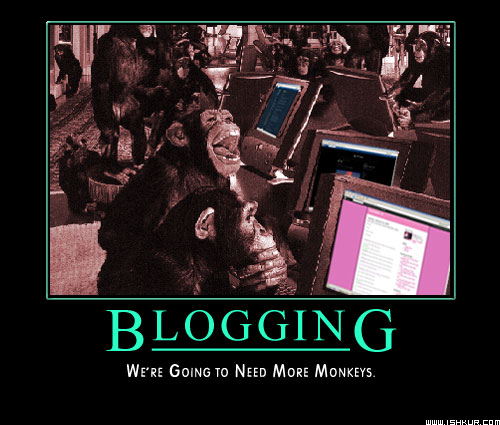
This seemed to have worked. I for one am impressed. To what degree I will employ this lovely feature of Blogger.com is an unknown, but that it works fairly well and rather easily is something of a boon on technology's part. Many are quick to denigrate the role of technology in making our lives interesting and entertaining. There are of course many, many downsides to technological progress. I think the disconnectedness that can occur when one spends too much time on the internet, the rapidly developing weapons of Mass Destruction, the reliance on technology to do the things that at one time people could do, maybe not as quickly or as accurately but added that touch of "magic" for a lack of a better word that made human constructed items "charactered" all represent the dangers or problems with technology. But Ipods are neat, Blogging though occasionally ridiculous-also fun. Blackberries and other mobile telecommunication devices are so useful it's scary. So perhaps like much else in life, technology is a mixed bag. But I think in the end, it comes down to how we use technology and not the other way around, yet!


Monday, March 13, 2006

She Wants Revenge...


The latest buzz behind the band She Wants Revenge...
and their eponymous debut is an example of the latest tendency in the media to define, restrict and categorize with accusations anything which the poor, unsuspecting listener might believe is different. This San Fernando Based duo (Justin Warfield and Adam Bravin) have released an excellent debut. What becomes of them and their future exploits is yet to be seen. However, this release is fundamentally sound and there are no noticeably weak tracks outside of maybe the first one, "Red Flags and Long Nights." Their press though is disgustingly predictable, comparisons are constantly being made to Joy Division (New Order), Bauhaus, and early Depeche Mode. As if to call out the band in some sort of conspiracy to claim their "sound" as unique. See Panic! At the Disco, reviews as another example of this type of call out. To the actual comment itself, if you mean having hard driving slightly-ominous bass chords and synthesized instrumentals behind a strangely disconnected, slightly tinny yet melodic voice singing retro post-punk Goth 101 lyrics, then yes, they sound like Joy Division or Bauhaus. But to the degree that this should be taken as a meaningful comment is suspect. If you do like those bands, than I imagine that you will, in fact, like She Wants Revenge, but even if you don't and moreover if you have never even heard of these bands (listen to music before you were born people...) you may think this band has something to offer. Part of the irony of She Wants Revenge especially as regards their press is that they are so thoroughly aware of their predecessors. For example, their name "She Wants Revenge..." is probably a fawning homage to New Order-Peter Hook's side project which was called "Revenge." Moreover, their first single, "Tear You Apart" is probably a reference to Ian Curtis' much loved "Love Will Tear Us Apart." However, The video to this first single is thoroughly contemporary and facetiously so at that. Directed by Joaquin Phoenix, it is an uber-Drama, full of lipsticked pseudo-goths running around narrow streets and dark clubs wearing clothes from a bizzaro-Salvation Army store, it even has subtitles-English subtitles (trey arthouse). But I think the Amazon review has it right, it is so blatantly borrowed so clearly derivative-that it has to be intentional and ironic. For the reviewers and pundits (myself included perhaps) that don't see that are missing the point. I think the only way that "She Wants Revenge..." is fooling people is how good they really are.

Sunday, January 22, 2006

Zombie Twin Philosophy

No qualia here...come back with more Brains.

Friday, January 06, 2006

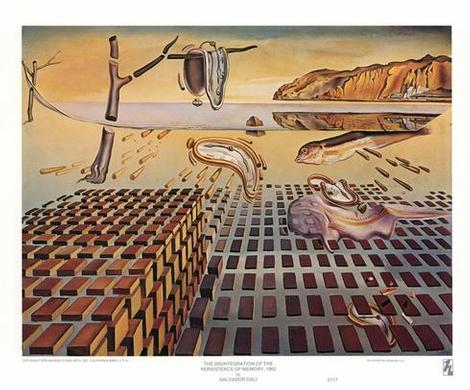
Dali's "The Disintegration of the Persistence of Memory"

In the Disintegration of the Persistence of Memory from 1954, Dali disintegrated the scene from his popular 1931 painting The Persistence of Memory, located in New York's Museum of Modern Art. This disintegration is an acknowledgment of the developments of modern science. The disquieting landscape of his earlier work has here been shattered by the effects of the atomic bomb. All of the elements in the painting are separating from each other. The rectangular blocks in the foreground and the rhinoceros horns floating through space metaphorically suggest that the world is formed of atomic particles that are constantly in motion.
Forms disintegrating as a result of the bomb populate the barren landscape. The soft skin of the face to the right is fluid, and the soft watch from the 1931 canvas is not just draped over a branch in the dead olive tree, it is ripping apart. By locating this work in the barren region of the Bay of Cullero, Dali revealed that the atomic bomb has disturbed even the serenity of the artist's isolated Port Lligat. Yet in spite of this painting's bleak implications, Dali presents the atomic disintegration in a harmonious pattern, indicating the persistence of an underlying order in nature.

Tuesday, January 03, 2006

Picture the Floating World?


"Artists of the Floating World" this expressive phrase can be found in Memoirs of a Geisha. According to the novel it refers to the role of Geisha in Japan and it hints at the seeming "ungroundedness" of the world of beauty and entertainment. It is particularly evocative as it simply and effectively describes the unconnected nature of such a world with the deeper "reality" that lies beneath. Or so one might intimate as an English speaker. It is related to the artistic style in Japan known as Ukiyo-e or "Pictures of the Floating World." These pictures are of landscapes, pastoral scenes, kabuki theater, and pleasure quarters. Hokusai and Hiroshige are perhaps the two most famous practitioners of this style of woodblock prints and painting. The picture here is one of Mt. Fuji by Hiroshige, one of his 53 Stations of the Tokaido Series. Hokusai is also extremely well known for his 36 Views of Mt. Fuji. Though, he is most famous for the often appropriated The Great Wave at Kanagawa. This understanding of the "Floating World" is a unique and genuinely frustrating concept to parse out. Are we in the Floating World? Does this apply to people, places and things...or is it a manifold of sensible perception, or a state of being? Moreover, does the Japanese understanding of the word "float," have any connection to ours. Should we be appropriating this term in novels about Geisha, of which we perhaps do not understand the role they played within Japanese society? Something suggests that perhaps, "The Floating World" is no less real, or important and is no "lighter" than other worlds or realities.

Thursday, December 22, 2005

All that is solid melts into air

all that is holy is profaned, and man is at last compelled to face with sober senses his real condition of life and his relations with his kind."

-Karl Marx and Frederick Engels, The Communist Manifesto

Are we disintegrating ourselves into milieu of our own technological sophistication?
Is our impulse to globalize dangerously feeding our desire to fractionate?
Are we at last compelled to face the real conditions of our life and the life we share with others?

The Communist Manifesto is perhaps still one of the most interesting critiques of the phenomenon of disintegration, not only as it applies to the bourgoisie's ability to disintegrate the proletariat's identity of herself and her relation to her labor, but Marx's impact upon the world is scarecly to be underemphasized. Though this book does not have the answers to the problem of disintegration, and perhaps this book and his movement did more to accelerate the world into the direction we may be headed into now...the questions it raises are important.

It is often suggested that the questions are more important than the answers. For those that seek just answers are doomed to an ideological abyss. That it is the search for questions that keeps one afloat in a world which seeks to drown us under the weight of our tasks and our emotions. Should we forever be buried, drowned in a sea of daily life.

Or, is this just one step of many? Not the first or the last, but a cyclical journey between holy and profane, innocent and guilty, naked and nude.

Is Disintegration the first step towards reconciliation...

Sunday, December 18, 2005

The Third Column

Paracelsus, called Alchemy the Third Column of Medicine.

Wednesday, December 14, 2005

Evil's Mirror

"Justice must never mirror evil, Justice must always be a mirror for Evil so that all may see."

How does one define struggle? It seems that we enter to each new experience in life struggling to get out of the previous one. Does one wait for the next great conversation to happen, so that we may be transported out of the existence we so often berate for its condition. The things we carry along, weigh us down so heavily-you see it people's faces. It hurts, you see it in people's art-it hurts. You see it in people's writing (it does hurt). That we struggle constantly to express ourselves to be recognized even through non-recognition, to be accepted through non-acceptance, to be honored through disgrace. The internal conflict grows in some, and it is often debilitating, but I only fear when there is only resolution in their hearts-then one is capable of anything anything. It is this conflict which gives us access to the other, and in other lays the possibility for the transcendent. The other contains that which we cannot see but would be all the richer for us to be able to understand. To be able to see the other as another self-not identical perhaps not even compatible but just to recognize the other (all others even enemies) as one who also shares in inner conflict. This inner struggle which tears asunder that comfort and creaturely satisfaction that comes with blind emotion, the need to check ourselves before we wreck ourselves. To check out the other before the other checks out on us. If we are unable to seek reconciliation with the other we will be forever lost in the immanent, forever stuck in time-to live out our finitude in crass animal-like existence, seeking to take our next meal our next conquest...always seeking never finding. We must have insight if we are to find justice, and we must be willing to look into another's eyes and not to see fear, danger, but acknowledgment, hospitality, reconciliation. We do not have to love each other, that is perhaps a possibility that only exists in the paradise that is promised to us in the afterlife, besides...our embodied, temporal nature will not allow us to love in the way that would be suited to such an expansive outpouring of feeling. We must however learn to really see each other, not as a side or an argument or an enemy but a person struggling with his or her own humanity-struggling to connect to something greater, or at least different. Connecting struggle to struggle, forever. See with the eyes of the other gives us the ability to reflect evil for ourselves and not to recapitulate it in self-justified acts of violence (not just physical violence, despite what the kids say words can definitely hurt you). To see with the other's eyes, even if we do not see it that way ourselves, can serve as a mirror for Evil, and justice does not have to operate like evil-the avenging left hand of justice can be tucked away so that the loving right hand of justice may sweep us away like scared children waking up from nightmares. These nightmares get stronger and though they sometimes frighten us, the power of these nightmares comes from a place that is much harder to locate and one that is much more immediate than fear and that is pain. The pain of failure, the failure to communicate, to connect, to understand. It begins in youth through confusion, a friend's mommy won't let you play anymore with your friend. It continues into adolescence through physical torture, you get beat up or tossed around because they don't like you, even though you have never said anything to them. In young adulthood anger and frustration, why can't they understand, why must they be so ignorant. In later adulthood, disappointment that your efforts though valiant were perhaps in vein. Finally, in the twilight of your existence a small yet very noticeable hole, missing, what is it-this world you are leaving has torn something out of you, has torn that piece of humanity which could have opened you up to the other could have opened you up to the infinite. It has been ripped away by the banality of society. We are wallowing in a filthy lake of hatred and it is eating away at us. We see it coming, we even see it in others (if we are lucky) in their art, in their writing and in their faces...it hurts.