Monday, July 30, 2007

The Lions of the Two Rivers

Yesterday, in a brief reprieve from the harsh realities of occupation, the Iraqi people celebrated victory as their national team, who were overwhelming underdogs, managed to beat Saudi Arabia 1-0 in a hotly contested Asia Cup finals, thus securing the first such championship for the "Lions of the Two Rivers." Though the traditional celebratory gunfire did result in a few unfortunate deaths and a handful of injuries, the warnings from government officials as well as the mosques did keep the accidental violence to a minimum. The well placed corner kick in the 71st minute, coupled with a critical error from the goalie, who horribly misjudged the trajectory of the ball, resulted in the only goal of the game. The header was beautifully executed by the captain Younis Mahmoud, a 24 year-old striker, who currently plays for Al-Gharafa, which is a Qatari League Team.  The performance of the National Team at the Asia Cup for the past few weeks had been well-monitored by the Iraqi populous eagerly anticipating Iraq's performance, with each successive victory leading to greater and more boisterous celebrations.

        A far cry from a few months ago when  in April mired in controversy, strife, and general frustration (I think for obvious reasons), the team hired Brazilian coach Jorvan Vieira. Only seven weeks prior to the start of the Asia Cup, Vieira a convert to Islam accepted the job after three previous candidates rejected the position after receiving death threats, his own assistant could not come to Baghdad because he received threats that his son would be kidnapped. However, Vieira, who has a doctorate from France in Sports Sciences and speaks seven languages, galvanized his team and had them prepare for the Asia Cup in Amman, Jordan. The team is made up of all three major religious and ethic groups in Iraq: Shi'ite, Sunni and Kurds, and he managed to unite them under his calm and professional leadership. Vieira is no stranger to coaching in the Middle East, he assisted Jose Faria and led a plucky Morocco to its second World Cup in 1986.  While at Mexico '86, they became the first African team to win their group and advance to the second round, a group which included England, Portugal and Poland losing a close second round match to the eventual runner-up West Germany.

       The 54 year-old Vieira has coached a number of club and U20 national teams in the Middle East, and despite cobbling barely enough players (six) just six weeks prior to the Asia cup to start a training session, his real work has been in attempting to unify the hearts and minds of his players. Watching the on-the-pitch celebration, the lines between Sunni, Shia, Kurdish were blurred by tears of joy and disbelief.  A dream run if there was ever one, undefeated and only conceding 2 goals during play, the Iraqis also handed pre-tournament favorite, the Socceroos of Australia a stunning 3-1 defeat on their way to their first Asia Cup title.  

The post-tournament press conferences revealed the good work that Vieira and the rest of the Iraqi National Team staff have done in promoting team unity. Nashat Akram, a midfielder and man-of-the-match winner, proclaimed that this victory sent one message to the rest of the world, "The message is that there is only one Iraq, Iraq belongs to all its sects and all its people." Captain Mahmoud suggested less positively yet with the same nationalistic bravado that he wanted America out, "Today, tomorrow or the day after tomorrow." State television minutes after the victory reported that Nouri Al-Maliki, the recently much maligned and embattled Shi'a Prime Minister of Iraq, would reward each player with $10,000 dollars (Iraqi). Unfortunately, many of the players cannot return to collect that reward since some insurgents apparently do not like soccer and have threatened them or their family if they returned to the country. Also in a wise and prudent move, Vieira has announced that he would step down as head coach in a press conference after the victory, comments amusingly reminiscent  speech given by Bush on the USS Abraham Lincoln way back in 2003, "I have worked my best to give happiness to the Iraqi people, to bring a warm smile to their lips and my mission is accomplished."

One victory in Central Jakarta will not lead to lasting unity, but as a general believer in the salvific power of sport; it is nice to know that the Iraqi people for the past month have had something to distract them, and that something, for once, didn't let them down.

Friday, July 27, 2007

Everybody Panic, possibly!

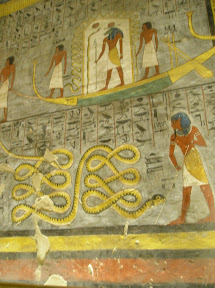
 Standing on the dance floor surrounded by the din of the Wednesday night bar crowd and staring blankly into spaces unfamiliar and faces unreachable, I noticed that Late Night with Conan O'Brien was on. His guest that evening was Neil de Grasse Tyson. The latest in a string of physicists to explain all things cosmic, his apparent street credentials garnered him an audience with the august Mr. O'Brien. Mr. Tyson, one of Time Magazine's 100 most influential people. He was discussing among other things a relatively significantly sized asteroid that has a pretty good chance (pretty good as far as the mind-boggling expanses of deep space allow) of striking the Earth. Originally calculations had the 1000ft diameter traveler striking in 2029, further refinements now suggest that the close fly-by to Earth (so close that it should make a bit of show as it streaks by), specifically Earth's gravitational pull, will alter the trajectory of Apophis in such a way as to set up a possible collision 7 years later on April 13th, 2036 to be exact. Apophis is a Hellenization of the name of the Egyptian Demon Apep.  A water snake (pictured left, taken from a Temple in Luxor) he will be slayed by Ra.  This of course nicely predetermines the name of the ship/mission that will be sent up there to destroy the asteroid in case the calculations turn out to not to be in our favor. The movie that results should be great, "Armageddon II: Ra Ascending," Bruce Willis' cryogenically frozen body will be reanimated just in time for the sequel and when he is done he can begin work on "Die Hard 14: Please Just Die."   The mythological references aside, Tyson informed Conan that "top people were working on this" (pause for sarcasm). The chances of this rocky formation slamming into our dear planet is somewhere around 1/5000 to 1/45000. These are not necessarily overwhelmingly dire odds, but nevertheless some at NASA are concerned, and have begun to develop response strategies in order to potentially avoid disaster. The other factor in Earth's favor (one of the few things that are her favor these days) is that the size of the asteroid  will not cause catastrophic damage to the entire planet; however, scientists predict if it were to strike, significant local or regional damage would occur. With all the asteroids and meteors and other NEOs (Near-Earth Objects) how was this possibly threatening one discovered. The Spaceguard Survey since 1998 has been devoted to discovery, tracking and assessment of these objects. The graph to the right shows the orbits of the terrestrial planets along with the orbits of the 100 nearest-to-Earth objects. The Spaceguard, which took its name from a similarly tasked research body in the Arthur C. Clarke novel, Rendezvous with Rama, has quite a lot to look after with a modest budget of approximately $3.5 million per year. Reading the white-paper on this research body is a bit of a jarring experience, considering the catastrophic consequences that abound in between the lines. For example consider this snappy line from the Spaceguard's documentation:

Indeed, during our lifetime, there is a small but non-zero chance (very roughly 1 in 10,000) that the Earth will be struck by an object large enough to destroy food crops on a global scale and possibly end civilization as we know it (Shoemaker and others 1990).

"Small but non-zero chance." Comforting, eh? If one becomes concerned about everything in the universe of which there is a small but non-zero chance of occurring then perhaps one would soon be committed to a mental institution suffering from an extreme case of depression and/or paranoia. Nevertheless, I am bemused by the fact that we are surrounded at all levels: locally, nationally, globally, and cosmically by threats and perceived threats (both true and false) to our existence, and despite our occasional complaints about an unnecessary cultivation of fear in our society prompted by our media and our administrations, we are often ignorantly quiescent to many of the less publicized but nonetheless possibly cataclysmic imperilments that we face on a daily basis. More entertaining is that there are people whose job, on a daily basis, is to analyze and consider these imperilments (I am sure many of whom are inside the Beltway) with all the perfunctory flourish of a mailroom attendant.  I imagine water-cooler conversations must have a hint of an additional gravitas or maybe they still talk about how much the Redskins need help. Though the sky is not falling, and the bad men aren't always knocking at our door I wonder how much we'd care if we knew they were. Generally, I feel that it is dangers such as this, though not particularly asteroids crashing into Earth, that really are worth fretting over, and many of the so-called dangers to society that are hyped up in the media or by government officials are the things that are the least doom-spelling. The incurious attitude adopted by so many finds me standing in a bar disappointingly alone in my thoughts, looking intently at the TV screen, wondering if I looked hard enough or stood still enough someone else would notice.

Wednesday, July 25, 2007

Hyperbole Shrugged

      On December 6th, 2006 Norman Borlaug won the Congressional Gold Medal. The Congressional Gold Medal is the legislative equivalent to the Presidential Medal of Freedom and not to be confused with the Congressional Medal of Honor which is a military distinction. Most, if they were asked to name the only two living American-born Nobel Peace Prize Winners, the name of Norman Borlaug would be slow to follow the honorable Jimmy Carter (those who might suggest that Kissinger is still alive must remember that he was born in Germany, although with that deep guttural tone which smacks of authoritarianism, how could you forget). Norman Borlaug has been called many things: a father of the Green Revolution, Greatest Living American and perhaps if you are a fan of the television show "Penn & Teller: Bullshit!" you will recognize the title the "Greatest Human Being Ever." It has been estimated that this man has saved close to a billion lives. His primary contribution to the world has focused around developing new techniques to increase the world food supply. His research has led to high-yield, disease-resistant wheat and other essential agricultural crops. Still very active and sharp at the ripe age of 93, giving his well-delivered acceptance speech without notes; it is inspiring to read about his single-minded commitment to augmenting the world's food stores, a commitment that has garnered some negative criticism due to the input-intensive nature of his farming techniques as well as his development of cross-breeding and genetic engineering techniques, which have been claimed to be unnatural or damaging to the environment. Mr. Borlaug despite his numerous appellations continues his important work as an advocate of responsible and effective world food supply management. If you are interested there is an excellent biography, The Man Who Fed the World (Durban, $25) by Leon Hesser, with a foreword by the other currently living American Nobel Peace Prize winner former President Carter.

     The competition for the honorific  "Greatest Living American" is not a one horse-race, in fact, according to Google, it is none other than Mr. Stephen Colbert. Through a grassroots Google Bombing campaign he has managed to earn this well-deserved title.  In a further attempt to alter the public discourse, Colbert has suggested that the phrase "Giant Brass Balls" be the most popular searched phrase. Though Colbert's character in the show is a self-aggrandizing, cartoonishly conservative flagophile; his efforts have been warmly accepted by the young, and by the confused and generally awkward glances from the audience coupled with icy stares from the First Lady he received at White House Correspondence Association  Dinner on April 29th, 2006, general derision from the established (read: old) media outlets and the current administration. His latest attempt at shameful self-promotion (let us be clear that it is us who should be ashamed or so I think the unconventional wisdom would suggest) is a book to be released on October 9th, 2007 called humorously enough I Am America (And So Can You!) (Grand Central, $27). Apparently, it has already received the Stephen Colbert Award for Literary Excellence, so it is sure to be a page-turning read or if I were channeling Michio Kakutani, the enigmatic New York Times reviewer who will probably get her hands on an errantly released copy of this work as well,  "Colbert's limber voice seamlessly shifts between high satire and low digs at the tabloidized media, the evasive administration and the knee-jerkable public, a riotous romp through America's political and cultural landscape."

     That particular dinner speech was hilariously funny and unbelievably audacious, his calm and collected demeanor in an increasingly antagonistic crowd speaks to his talent and composure. Some have impugned exceptional importance to it, Frank Rich specifically suggested that that speech was a "cultural primary" and labeled it the "defining moment" in the 2006 mid-term elections. Despite the minor coverage over the controversy engendered by Colbert's 16 minute vicious invective, its genuine popularity is a direct result of the masterful utilization of the Internet and the much bandied about Web 2.0. Colbert has done a magnificent job, better certainly than any of the candidates in the 2008 Presidential Election, if the feeble YouTube videos contrived by their respective campaigns is any indication, of monopolizing the bandwidth of the denizens of the Internet.  Perhaps in the "Colbert Report" introduction he could add "Puppet-Master" to his growing list of self-congratulatory sobriquets.

Perhaps not....

Colbert and other have capitalized on the American penchant for Hyperbole in their media diet. Despite its unhealthy side-effects (it is of course terribly deficient in informative vitamin rich content and it is mostly fluff), the public loves a good outrageous claim (see Mike Gravel/Ron Paul), regardless of its "truthiness." Though I do not claim to have some special epistemological access to the truth and all its treasures, nor do I suggest that I or anyone else can be completely oblivious to the social and cultural conditions which facilitate this sort of obsession for aggrandizement; it must strike some as odd, if not just interesting, the continued misguided prioritization of and focus on the major issues and people that exist in our society and around the world. Perhaps it is the fact that real problems require real solutions, and such solutions are usually  long, hard, complicated and boring. Those solutions involve standing a wheat-field in Mexico for hours for months on end taking measurements of soil pH, and seed growth. These solutions require committed focused individuals who can shrug away alarmism, elitism and baseless criticism, public notoriety and must have their feet on and ears to the ground, the right ground (not D.C. but Baghdad). These solutions require serious people. The irreverence displayed by such shows as the "Daily Show" and "Colbert Report" all too easily highlights the lack of seriousness often present in our politics and exhibited by our politicians, by seriousness it is important to recognize the distinction between it and drama. Drama is a cheap simulation for resoluteness and purposefulness. Drama is the all night debate staged by the Democrats on the situation in Iraq which took place last week. Seriousness and earnestness are the illustrated by the real sleepless nights that members of our armed services are faced with on a somewhat regular basis, the two should never be confused.  We must shrug off the seductive nature of hyperbole so that we may bear the burden of a sometimes harsh reality.

Borlaug 1 Colbert 0  

Thursday, July 05, 2007

Steroids Possible Factor in Glasgow Bombings

Newspapers out of Scotland report that Alex McIlveen (pictured right), a local  Glasgow taxi driver became the latest addition to a list of growing local heroes, when he confronted the bombing suspects immediately after they crashed their fuel-filled Jeep Cherokee into the Main Terminal. Upon approaching one of the suspects, who happened to be in flames due to the resulting explosion, the father-of-two did what any self-respecting Scot would do and nailed the burning terrorist right between the legs with a ferocious kick, reminiscent of anything you might see at a Celtic vs. Rangers fixture (in the stands, no doubt). Much to the surprise of the heroic cabbie, the conflagrant would-be bomber seemed to be oblivious to the blow, "he didn't even flinch," McIlveen reported. A doctor later informed Mr. McIlveen that he had managed to tear a tendon in the altercation. Unfortunately for the cab driver, he also had his Nike trainers taken, due to the impeding investigation, and received a parking fine for his troubles as well. The Daily Record reports that the terror suspect on the receiving end of this "kick felt round the world," was the Lebanese doctor, Khalid Ahmed.

Though just speculation at this juncture, one cannot rule out summarily the possibility of steroids being a factor in this incident. Typically involving long well-planned out and pre-mediated affairs which may take hours or even days to transpire;  the Chris Benoit murder-suicide case is just the latest in a series of possible "roid-rage" related incidents to have transpired in recent history along with: the judge's decision to re-incarcerate Paris Hilton, the flare-up by Rosie O'Donnell on ABC's The View, many of the actions of Robert Mugabe and Hugo Chavez, the Iraq War and of course global warming. There are, in this episode however, possible signs that point to anabolics potentially playing a significant factor. One, the erratic, impatient driving evident in the alleged terrorists' action is a common symptom of roid-rage. Furthermore, the non-reaction to a massive kick to the jimmy might be indicative of a severely shruken set of testicles, and with the added hormonal output a near obliviousness to all forms of pain as illustrated by the fact that Ahmed was still in flames at the time of the booting. It also cannot go unmentioned, as these foreign doctors worked at a local Glasgow medical facility it is quite plausible to assume that they had relatively easy access to this cholesterol derived rage-juice.  

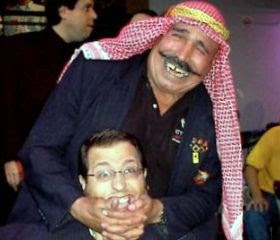
Though toxicology reports will not be published or released for weeks even months, the steroid usage of Islamofascist groups as well as Al-Qaeda should certainly be monitored. It is also clear that Vince McMahon's avoidance of the steroid question in the Benoit case should raise some red-flags and will perhaps lead to an investigation of his overseas and possible terrorist connections. It is a well-known fact that the WWE has long had in its employ, an Iranian by the name of Khosrow Vaziri, who has gone under a number of aliases, no doubt to throw off any possible inquiries by authorities. He is perhaps best known for being The Iron Sheik, one half of the "Foreign Legion," along with Russian-wrestler Nikolai  Volkoff.     Pictured below demonstrating his famed Camel Clutch on an unsuspecting stockbroker, no doubt trying to procure funds for "charity" organizations, he has long had sympathies for the anti-US stance held by Iran. Though he was recently inducted into the Hall of Fame by longtime rival Sergeant Slaughter,  interestingly enough, on a June 18th, 2007 episode of "Monday Night RAW," the Sheik requested of Jonathan Coachmen, a representative of WWE and an associate of Mr. McMahon's as well,  that he be offered a segment on the show. Coachmen implied that he thought the idea was interesting and would take it under consideration. Perhaps this segment is payment for services rendered on behalf of Mr. McMahon for certain covert overseas operations. A further inquiry should soon be underway.

The issues here are quite subtle, but the coincidences speak for themselves. A touchy CEO with known terrorist sympathizers on his payroll subverting questions about Chris Benoit's medical history, a tendon-snapping kick administered to the likely miniaturized  testes of a potentially nonplussed but generally unresponsive candescent Lebanese doctor, a pro-Iranian wrestler asking for blood money in the form of airtime one week prior to the tragic murder-suicide of the Benoit family and two weeks before this botched bombing attempt; I don't need a needle sticking out of someone, evidence, a medical degree, or even a coherent, plausible explanation to make the connections here. There is a growing menace to the current world order and that menace has a solid polycyclic alcohol with a hydroxyl group at the 17th carbon atom, possibly alkylated, dripping out its syringe and popping out of its blister pack. 

Steroids, yesterday it was baseball records, today its Islamofascism, and tomorrow possibly world domination, if we don't stop this menace in its acne-covered tracks.

Tuesday, July 03, 2007

The Condemnations of the Anointed

730 years ago a French Bishop by the name of Etienne Tempier, conducted what is known as the Condemnation of 1277. Though the specific motivations for this instance of condemnation are unresolved, some suggest that it was papal mandate while evidence suggests that the Pope though not disappointed by his all-to-eager Parisian Bishop's enthusiasm was surprised to learn of this rejection of some 219 various philosophical and theological treatises and propositions. In any event multiple members of the faculty of arts at the University of Paris were condemned and their works and thoughts were placed on the syllabus of errors. According to the Stanford Encyclopedia of Philosophy, the radical condemnation of the faculty can be seen as either one salvo in the battle between faith and reason, or Tempier's touchy temperament with the increasing rationalist or even populist currents growing in the university. He maintains that the philosophical fetishism which had been growing in academia created an atmosphere which supposed that, "...there were two contrary truths, and as if against the truth of Sacred Scripture, there is truth in the sayings of the condemned pagans." This is a reference to the hermeneutic strategy misunderstood as a metaphysical assumption, which is the doctrine of double-truth. The doctrine of double-truth states in its strong and never defended form that there are two truths, one revealed by Scripture and one revealed by man's reason. The other weaker form of the doctrine offers that an individual proposition can be analyzed from the standpoint of standard theological investigation, or from reasoned philosophical inquiry. I think the genuine fear was that intellectual effort, which was effective, persuasive and interesting was being performed outside the domain of the Church, and that this heretical trend if allowed to fester would infect society with a sickness, a sickness of independent thought.

Cross a few centuries, through the Renaissance, the Enlightenment, the Romantic reaction, the modern era, and the Postmodern and we arrive here, in the fascinating age of the Internet and the so-called Web 2.0.  Where the free exchange of ideas, the rise of the Instapundits and YouTube-celebrities and the cacophonous blare of the blogosphere are delivered via the titter-tatter of keyboards in the wee hours of the morning. The fingers responsible for this titter-tatter, driven by inquisitiveness, caffeine (or perhaps harder fare) and apparently a Cult of Amateurishness. A recently published polemic, The Cult of the Amateur (Doubleday, $22.95) by Andrew Keen, is the latest in a series of relentless attacks on all the amoral evils and stifling discourses Web 2.0 has brought to culture. Of course, I am sure he anticipates the negative reaction he will receive from the citizens of the blogosphere; moreover, for those who are sympathetic to his position will see this as a vindication of his claims...insuring a vortex of non-falsifiability, Fantastic. I will not go into a review or point-by-point analysis of this book; however, if you go to Lessing Blog, you can see such a breakdown. What is interesting about his interpretation is that he claims the book is self-referential satire laced with a great deal of irony and hence should be considered a fantastic boon to the bloggers of the world instead of a call to arms. I will leave this an open question. 

Mr. Keen (ironic or not) is not alone in his condemnation. Nicholas Carr over at RoughType, seems to have a special place of hatred for Wikipedia.  Yet, it seems his anger, and those who would agree is either misdirected or self-agitated. Look at what he has to say about the conventional wisdom on Wikipedia:

Let me bring the discussion down to a brass tack. If you read anything about Web 2.0, you'll inevitably find praise heaped upon Wikipedia as a glorious manifestation of "the age of participation." Wikipedia is an open-source encyclopedia; anyone who wants to contribute can add an entry or edit an existing one.

Really? Inevitably find praise...Wikipedia is almost universally unacceptable as a valid source for papers written for a  high school or college level paper. Wikipedia is often mocked for its gloriously wrong information. Vandalizers and bad jokes put on Wikipedia have their own page on Wikipedia. I don't think there is the universal praise that Mr. Carr seems to be in such a bind about, I think it is a straw-man, a red herring. Moreover Wikipedia is not great as a primary source, but it is great in nailing down information that is supposedly well-known or canonical for a particular subject. Furthermore, many of the better edited pages have links to more authoritative sources, which are generally interesting and helpful.

What seems to be main argument here is that the Web 2.0 is undermining traditional media and traditional media's opportunity for making money, by overloading individuals' bandwidth for information, entertainment, news, arts, and culture.The traditional media outlets necessarily present better, more polished information that is independently researched, peer-reviewed, fact-checked, edited for grammatical and stylistic errors, marketed, etc...While, on the Web 2.0 side every, Tom, Dick, Harry, and Cindy (can't forget about Cindy) can put up whatever he or she feels like on the Internet, and it suddenly gains authoritative valence. However, the argument that seems so interesting for those that would bash the Web 2.0 is that relatively few people actually do those things. Some of the statistics presented in the book and on Mr. Carr's website claim that relatively few users, through Google Bombing and other related strategies have monopolized the blogosphere, and that individuals with no credentials are given extremely wide discretionary powers to decide what goes on major websites like Digg.com or Wikipedia. Isn't this exactly the sort of argument that was initially levied against big media a few years back, wasn't it maintained that relatively few companies had control of an overwhelming majority of the media outlets currently accessible, and that it would be the Internet that would break this hegemony. Second, this rhetoric is not functionally different from Francis Bacon's criticism of the Idol of the Marketplace in his masterwork Novum Organum. That there is the interaction between the free association of men, which leads to a confusing of language is a well-rehearsed argument.  Yet, the false learning and sophistry from supposed wise men to which the masses are to accept since they are the ones with the degrees, pedigrees, and copy editors, well Bacon has an Idol for them too.

 What I find intriguing about these sorts of attack is that it is directed toward their ostensible target audience. I started hearing these rumblings from the media industry, when the Atlanta-Journal Constitution decided to discontinue their book review section.  There is some suggestion that this was due to the influx of amateur book reviewers on the web cutting off advertising dollars from the print media. There was some backlash to this, and I think for the first time, those in the traditional media formats felt genuinely threatened and afraid for their welfares from a bunch of philistine Internet blog-fiends. But those philistines, those amateur book-reviewers are the ones most likely to pick up a copy of the Atlanta-Journal Constitution and read the section. Book-reviews on blogs are not so ubiquitous as to not avoid being seen. One may suggest it is only one click away; nevertheless,  it is still one click away. Most people who aren't looking for book reviews don't find them.

Finally, the claim that those on the Internet posting their random musings, have unchecked biases and hidden or not so hidden agendas is in danger of politicizing and relativizing all forms of media is also a common complaint. That genie won't go back into that bottle, if Richard Rorty (may he find his liberal utopia and final vocabulary in the sky) has taught us anything is that this is just a debate between two different sets of vocabularies the one of the amateur and the one of the professional. No one has claim on Truth, everyone has claim to truths.   Whining about the absent moral compass and the lack of a desire for objectivity of some bloggers which will lead to a cannibalizing of culture, is clearly a case of the "lady doth protest too much."

Though I don't want to,  I can't help but see a residuum of truth to their position, as transparently self-serving and unimaginative as it is. In Herman Hesse's outstanding The Glass-Bead Game, the scholars of Castilia are rather repulsed by a previous Age of culture called the Age of Feuilleton, the word comes from the French diminutive for leaf or book. In this age sensationalist, cute journalism, cultural criticism and the arts replaced serious reading and close reflection. It occurs at the end of the 20th century, to which the predecessors of the monks of the Glass-Bead game flee in order to reestablish order and proper intellectual edification. This age led to decadence and superficiality to such a degree that there was a massive breakdown in culture and chaos ensued. Though the action in the novel takes place sometime after this age; the concern over such an age is well articulated. I can't help but think that there is some resonance with the warning that Hesse is obviously giving us and the sort of pleas that books like the Cult of the Amateur are intimating.  I am not sure if such a warning is representative of plain unadulterated cultural elitism, or is their something genuinely more at stake. What is culture other than the sum of its participants? Can we really assess some type of moral imperative to impugn onto Culture in this day of relativism and postmodern antipathy towards Meta-narratives? 

Or is this series of condemnations, just like the ones of 1277 but this time it is not a concern of double-truths being promulgated but double-authorities being established? That in fact it is the Church of the Professional which is launching its own inquisition against the heresies and blasphemies of the Cult of the Amateur. Operators are standing by.

Sunday, June 17, 2007

Exasperation is a Dish Best Served Reheated...

I don't do many things well. In fact I am mediocre at a number of tasks, though I was told once that I drive really well in reverse. What makes this more pathetic than it might initially sound (as if it doesn't sound pathetic as is) is the person was attempting to delineate the things that I did really well, beginning the list with the above gem and unfortunately ending the list quickly thereafter. So, I am great driver in reverse, there are worse things to...be...good...at, I guess. Humility is something I that I think I am good at, you know, that polite sort of humility that really isn't humility at all but just a general self-effacement intimated to engender a sympathetic response. One thing I am genuinely and authentically humble about is writing. There are many, many, outstanding writers in the world-past, present, and no doubt future-some of them wildly successful and some, unpublished.

Most writers, writers in particular, are generally a humble bunch. Tormented by a language that never serves their emotive or literary purposes, they learn to respect the craft of writing and appreciate the difficulty in producing anything of note. Those artists however, they are an arrogant/tortured group of bastards, look what I can do, I can draw a circle freehand, give me the commission to build your Church. Therefore to meet or even hear about a genuinely arrogant writer is usually an interesting story, since 1) it is pretty rare 2) it is usually humorous, since their arrogance more often than not is genuinely unfounded. One such character is Edward Dahlberg. He believed in the humiliation that is writing, but because of his abrasive individualistic attitude, developed a distaste for the professional community of writers. He was in 1968, listed as one of the ten most neglected writers in the United States. Jonathan Lethem, in the title essay to one of his works, The Disappointment Artist, discusses the bitter existence of Mr. Dahlberg and his Aunt Billie's unfortunate run-in with the man. A recently graduated friend of mine introduced me to this writer and his work, and he happened to pick up a copy of his autobiography, Because I Was Flesh.

There is no better way for me to explain his writing style than to just show you and have you judge for yourselves. If you are intrigued by this passage, and become interested in reading the autobiography-let me suggest that you bring a dictionary, a Bible, and a primer on the last 500 years of Western Culture-just a suggestion.

In this brief passage he is describing the book he is currently writing:

This book is a burden of Tyre in my soul. It is a song of the skin; for I was born incontinent. Everything has been created out of lust, and He who made us lusts no less than flesh, for God and Nature are young and seminal, and rage all day long. I shall sing as Tyre, according to the Prophet Isaiah, like a harlot, and for seventy years.

Pretty freaking intense, eh? Gravely moral,  he is writing sub specie aeternitatis maniacally driven by the pressing weight of his own disappointment. The novel proceeds through his life much in this fashion, exasperating. Though it was a truly worthwhile read, and I gained much from it, the oppressively recondite passages demanding your submission were just too much at times. Dahlberg was a courageous, emboldened writer unafraid of being not understood, despite his deeply wounded psyche, he was not scared of the reading public and their quotidian demands.

This same friend who introduced me to the oeuvre of Dahlberg, showed me a website in which registered members could upload their poetry and have it searched by others. One word: Exasperating. A few more, simplistic, not just simplistic-they exhibited all the mastery of such emotionally complex issues as love, loss, and death as possessed by an elementary school boy. Moreover, versification, rhyme scheme, or rhythm were not terms familiar to these individuals. Perhaps, many of these individuals were in fact elementary school boys and girls, but having looked up a few of our colleagues who we knew to be on this site...sub-par. Poetry is a notoriously difficult literary form to make sound good, or original, or even authentic. Most of the poetry on that site suffered from stifling Harold-Bloomesque influence and horrible diction.

Though there are a number of great writers, many of whom are unpublished there are some authors who manage to get published that, well, one wonders who they had to drug, or sleep with in order to get this through the publishing house unnoticed. One example of such work is a poem I happened to read by Cin Salach. Yeah, that is her name-not protecting the guilty, that is her name. Sexy, kinda! I am unsure why or how I ran into this "poet," but again, Exasperation. I decided to write my previously mentioned friend an e-mail expressing my indignation at this Ms. Salach. Serving this in reheated form, the subsequent e-mail, in my defense, it was written fairly late at night after a long day of which I am a little proud, (by a little I mean a whole lot but again, that whole polite humility thing) by the way I apologize for the cursing but it is a spice in the dish of exasperation which adds a lovely flavor:

The purpose of my filling your inbox today with a message which barely passes as legitimate and which should not be sent to the Junk E-mail folder is a bit of a reminder of a distant episode (queue iconic harp-music indicative of a flashback) when you had introduced me to that website with a lot of really bad poetry. I was recently online, a scant few minutes before sending you this memorandum, and I had run across an Amazon.com “So you want to be…” whose appositional conclusion was “pretentious.” One of the works listed that trained one for the wide-world of pretentious pseudo-intellectual adult male cow feces, was a book of poetry by a Cin Salach called, Looking for a Soft Place to Land. Bad. Very Bad. I suggest you check it out and be encouraged by the fact that despite the saccharine simplicity of this woman’s poesy that she has somehow managed to get published, my only conjecture as to how this could have possibly occurred is that it might have something to do with her bitchin’ name Cin Salach. Perhaps you should change your name to something equally as retro-futuristic with just that hint of medieval Welch or Celtic. Spicy.

To leave you with an epic line from the oeuvre of Ms. Salach, "It is the language of words, and it is unlike anything I have heard with my fingers" now I will give her the benefit of the doubt on this one and suggest that she is either blind and deaf or referring to someone who is so-but that given that concession, YOU CAN’T FREAKIN’ HEAR WITH YOUR FINGERS (this capitalization in case you are unfamiliar with any of my particular idiosyncrasies, means that I am exasperated and serious, but mostly just exasperated). Also, let me suggest that there is something insipidly moronic about the phrase “language of words,” as opposed to what exactly…a language of éclairs. Moreover this Braille-fetished douchebag has apparently heard other things besides a language of words with her fingers; it is just this singularly unique and perhaps even fucking transcendent language of words which is so uncanny in its ability to carry sound THROUGH HER FINGERS (still exasperated). Perhaps if she used her ears, she would recognize that her poetry of words (because that’s how we use words, language, get into it!) sounds like cat urine smells, which by the way if you haven’t had a recent opportunity to smell cat urine, and consider yourself cosmically luckily in that case, cat urine smells bad, like the sulfurous clogged toilets of hell bad. Yeah, no good, no good at all.

So how are you and the kids? Misses doing well? How’s that new job in Duluth treating you? Banging the secretary yet, huh tiger?

XOXO,

Ahmad

P.S. I am tired, and papers do not write themselves. Stupid fucking papers.

Again, I don't do many things particularly well, and I wish I was better at a few things mainly: dealing with women, thesis writing and Guitar Hero II. But I've got driving in reverse, and indignant exasperation, but probably not humility after all.

Saturday, June 16, 2007

Walking Alone (Together) In a World of Wounds

Aldo Leopold, an environmentalist and wildlife management advocate, suggested that the  consequence of an "ecological education" is one will live alone in a world of wounds.  This, I read in a book about the current environmental "crisis," and America's role in responding to the changing global environment. Let me add that my placement of the word "crisis" in quotation is to suggest that the definition of crisis usually implies, a decisive point of change wherein a specific action must be taken in order to avert disaster. And there is something about the ambivalence expressed by the current and previous administrations, I include the Clinton and Bush the First administrations in that group-that doesn't seem to resonate with the impeding doom that this book, Red Sky at Morning (see right), suggests with alarming rhetoric and bass drum like consistency. Ignorance to a crisis does not invalidate the crisis' reality, I realize, but it all seems a bit surreal to me-headlong into disaster we are in rapt attention as to the incarceration status of Paris Hilton. It betrays a negligence which cannot easily be rectified.

      Mr. Leopold was probably exclusively referring to an education about the environment. But by "ecological education" I will take more broadly to mean, the type of education which grows in multiple directions, disciplines, and manners, and where these various trajectories of learning all intertwine and develop an 'ecology of consciousness'. The reason I use this definition because it seems more in-line with the type of education we will need to have in order to recognize and act on the coming "crisis." It isn't enough to be aware of the science, or the politics, or the economics of the situation. In order to feel the genuine impact of such a climatic realignment as predicted by some scientists, requires an 'ecology of consciousness', which recognizes and can evaluate from various points of contact what is at stake. A univocal education breeds a narrowness of vision, insufficient to adequately deal with the problems facing our planet. It is too easy to get caught up the facts and figures, climate data, oil prices, and financial statements which leads us to miss the "bigger" picture. However, it is equally seductive to become a hyper-idealist, head up in the sky, lamenting the loss of this species, the destruction of this lake, engaging in saccharine discourse about a bright summer's day, flagellation about what future generations will think of us and how we will be judged. There are important, difficult decisions that will have to take into account not only the environmental impact, but the current geo-political situation at work today.

     Some might protest that the concern with issues akin to inflation, infrastructure, political expediency,the dictates of the free market when our planet is on the brink, is unfounded. Indeed, some demand that our operating principle be that all other concerns are secondary to the impeding environmental crisis. Is your heart so pure, is your will so strong, to believe that such a principle can operate in the harsh realities of nation-state politics. Such a lofty ideal should be counted among such other pipe dreams as: the brotherhood of men and women and the eradication of illness. We are not citizens of the world, because citizenship has its privileges which are applied or at least paid for while we are thrown "free of charge" into worldhood.  Countries have competing interests, individuals and the state have competing interests, corporations have competing interests. Good, bad or indifferent,  in that competition the environment, social justice, and peace lie in the balance.

     Those who have developed an ecology of consciousness can more effectively deal with these problems in a world where moral imperatives unencumbered by pesky realities do not exist. However, it is as Leopold suggests a very lonely road. There are too many that fall by the wayside, too many that do not appreciate one subtlety or another and must be dragged along, those brave few who walk among the ruins are forced to pick up the pieces, because they know no one else will.

    Leopold despite being a life-long hunter and fisherman, or perhaps because he was those things, believed strongly that humanity has a deep desire to be with nature, a kinship if you will. Throughout most of human history, nature has been a force outside of human control, an entity, a being whose plans or goals were not amenable to our wishes or desires. James Frazer, Edward Tylor,  and other early examiners of 'primitive' cultures offered that the primary motivation for the development of religion was an attempt to mediate, or negotiate with nature. I think one of the most significant obstacles in convincing people that we must be the progenitors of action when it comes to resolving environmental issues is the deeply inculcated, historically reified belief that nature is a force that is to be conceived outside the realm of humanity, lying in opposition to humanity to some degree. The supernatural acts as an intercessor between the natural and the anthropological. Now, if environmentalists are correct-this conception of our relationship to nature has to be fundamentally altered and reconsidered. Now we must conceive of nature as a force that we are capable of manipulating, and more to the point, have already manipulated in potentially disastrous ways. To realign our thoughts in this way in light of such eco-events as Hurricane Katrina, the bird-flu, El Nino, Lovebugs (this is a very annoying and car-besmirching Florida issue) is understandably difficult, nigh impossible perhaps.  It is also the case, at least in terms of global warming, that there are arguments, some good, some not so good, that this is not an accurate picture of our relationship with nature. A number of books recently published by some conservative authors, who contend that despite the verifiability of the warming of the globe, that its cause is not anthropologically traceable, and other explanations such as: climatic cycles, stellar influence, God's wrath (seriously), must be taken into account. Of course, it is hard to trust these sources as their funding comes from places that initially sought to mythologize the global warming situation from the beginning, and now in the light of overwhelming data, must now backtrack to this next line of defense against the eco-alarmists. Though, I take those sources that spell out doom and gloom when it comes to the environment with a B-I-G B-U-S-I-N-E-S-S or A-M-E-R-I-C-A with an equally hard to swallow grain of salt; it seems less and less likely that the current ecological situation can be purely chalked up to normal climatic cycles, or stellar gases- as to God's wrath I cannot speak to, but the way we have been acting lately, I wouldn't be surprised if God was a bit miffed. Again, the whole debate is shrouded in so much political and cultural posturing that is so thick, so impenetrable as to render intelligent discussion as little more than emotivist ejaculations for one side or the other, like a Celtic-Ranger football game or the debate regarding a meta-ethical theory based on a Humean non-cognitivist program (those can be bloodily brutal, and the football games can get rough too).

     To invoke a Rortian-type query, requiescat in pace: Why is conservation something that must be argued to, why can we not for the sake of solidarity and care take it on principle that the Earth should be taken care of, not in lieu of or the negligent omission of the current economic, socio-political realities that will affect any proposed solution, but that without argument we begin from the premise that there is something good ipso facto about conservation. How we get there is a decidedly different story, I imagine but if the sky is falling then foolhardiness in the face of destruction is equally as dangerous as unreflectively swallowing the hysterical claims of all Chicken Littles that come before us.

    On a decidedly separate note, enduring a world full of wounds, and by wounds I mean not only the ones we inflict on the planet, but the ones that individuals inflict on others is a phenomenon which pleads for companionship. One item I have come to realize that the benefit of walking the wounded world with someone you care about, can be its own Salvific Doloris. A precious suffering born out of our conditional existence. As we float on from distraction to distraction painfully aware of our vulgar being, it is comforting to know that born from a biological desire to copulate that the possibility for transcendence is available. Though most of us choose to ignore that deep responsibility and opt for the instant gratification; that for those who feel deeply it is possible occasionally to step fully into that which makes us human versus simply abounding in that which makes us animals.

Friday, June 08, 2007

ManDate...

The urban dictionary defines a man-date as two men engaging in "normal" male-female dating rituals. The standard dinner and movie scenario. The picture to my left is an oft attached image of man-dating, two ostensibly heterosexual men holding hands and walking through a garden. Interestingly enough both men in their own way are the representatives of two hyper-masculine societies, which makes this little scene all the more jarring. There is a strange set of rituals involved in man-dating, and though a majority of heterosexual men have performed this ritual at least one time in their life, there are some unwritten procedures to the whole sordid process. Lest you think that this particular introspective arc is a bit strange, please consider the New York Times article, which takes up the same issue. What makes a man date, a "man date," depends on such factors as: venue, dress, purpose, seating arrangement and items consumed (for example, going to watch a romantic comedy versus 300, which if you haven't seen yet is the opposite of a romantic comedy). So, if two men are at a bar watching the game-not a man date. This is so for the following reasons:

1) When one is on a romantic date, each person on the date is responsible in large part for the other's amusement
Therefore in situations where the source of amusement is derived from somewhere outside the locus of the two individuals, then it is no longer a "date." This is the sort of adult male equivalent of playing-in-the-sandbox. Yeah, you're both there, and sometimes you share the dump-truck with your pal, but you guys aren't "playing" with each other, but just playing "together." In man-world we are just watching the game, rooting for the local sports team in general proximity to one another.

2) Usually at a bar, you are eating bar food and drinking beer/liquor--man food! Wings, burgers, fries, nachos, etc. If two men are at a sit down restaurant drinking wine, eating salads and other non-steak dishes, "man-date" is in effect.

The essential qualities of a man date require that if one of the individuals were replaced by a woman that the scene would be indistinguishable from a "regular date." Allow me to apologize at this point for the inherently heterosexist speaking position from which I am engaging in this discourse. Our language is fairly cumbersome in attempting to gracefully articulate "non-traditional" relationships, and in order to expedite the analysis I am forced into these horribly exclusive locutions. If indeed the placement of a woman in such a situation makes it indistinguishable from a normal date, then it is possible that any distinction made is a false one, i.e. they're gay. Though women have gone out together in this way for many years with minimal potential misidentification as lesbian, men engaged in such activities where the purpose is not obvious, i.e. sports, business, or getting wasted, then this ambiguity tends to raise suspicions regarding the men's sexual orientation. I believe this is because, men are supposed to be paragons of efficiency and practicality. Men just don't do things for the sake of doing them, e.g. men don't just call to say "hi" (I don't do this, and I don't see why calling to say "hi" to anyone is ever done, some enlightened male or situationally aware female will have to explain this strange and seemingly gratuitously unnecessary phenomenon). If a man is on a date with a woman, or so the stereotype goes, then either he is a)trying to sleep with her, b) already sleeping with her and trying to get her to do more interesting things sexually, c) they are married, and it is their anniversary, or d) he screwed up and is trying desperately to resolve the situation. Therefore, if two men are not clearly on a business, sports, or an alcohol focused engagement then the default switch is set to "trying to get laid."

Male intimacy is a difficult topic for most individuals to articulate fully. For men, the interactions are most robustly experienced when there is some mediating "exchange" that interpolates between the two agents. Whether it is football, or shop-talk, the activity of bonding occurs as an epiphenomenon to the task at hand. "Hanging out," just to hang out, is as the kids say "freaking gay." As the humorously yet disturbingly strange "bro-rape" videos on YouTube illustrate, such a situation tends to raise suspicions. In an article I read for a class on the Philosophy of Love and Sex, the notion that men develop their "fifth set of essential friends," when they, for example, move to a different city, or start a new job, is a common behavioral trope which is destructive to male intimacy. Men use friends as boys use toys in the sandbox, important and fun while they are playing together, but when they come home, they take a shower and clean off all the sand. While women, the article suggests, are more likely to develop fewer yet longer lasting relationships with friends across the various periods in their life. A woman is much more likely to meet an old friend from high school for dinner, even though she has already been to college, and has worked two different jobs. While the article implies that a man will more likely hang out with all of his current work buddies from Tuesday to Saturday nights at the local sports bar with little regard for the sets of relationship he has compiled in the past. One of the many consequences of homosexuality is that it further makes ambiguous the supposedly clear lines of demarcation of male and female behavior, this consequence is one that plagues various spheres of political and cultural landscape-though it should be noted that such lines have, for the most part, always been blurred, i.e. the man date. At the recent Republican Presidential debate, when Wolf Blitzer asked the candidates if any of them thought it would be acceptable for openly gay men and women to serve in the armed forces...crickets.

This last issue is definitely for another time, but just remember if you are on a man-date, keep this simple rule in mind:

Do not, I repeat, do not share the dessert. You are just asking for trouble, or at least questions-which is trouble enough.

Sunday, June 03, 2007

Books and the Fires that Love: A Hate Story

A local owner of a Kansas City, Missouri bookstore, Tom Wayne, decided to burn some of his inventory to protest the declining status of the printed word in the United States. Wayne, the owner of Prospero Books, determined that an unread book might as well be burned. A number of local readers were able to save a number of volumes before the burning commenced, getting some great deals on books-bringing old meaning to the term "fire sale," to be sure. One immediately might suggest that despite the declining readership in KC, it might be possible to have the books transferred to another library, or an under-funded school (I hear there are a few of those). Mr. Wayne claims that those outlets were explored and they were not particularly efficacious in moving his inventory. As a result a 45 minute burning commenced until law enforcement asked him to put it out, since he did not have a permit to burn outside. At first this seemed a bit of a strange and disconcerting inversion of the "book burning" trope that is prevalent in some literature. In the case of Ray Bradbury's Fahrenheit 451, the government is the sponsor of this literary-terrorism, while the general populace is anesthetized by the hyper-decadent anti-utopia found in Bradbury's 24th century America. The symbolism of book burning is a powerful and often devastating one, signifying horrible portents of mind-crushing oppression and tyrannical political coercion, envisioned in the nightmares of intellectuals, SF writers, and the patrons of the humanities. As Franz Boaz notes, "[the] banning and burning of books is the symbol of tyranny's fear of the power of the free-mind."

There is a particular wantonness associated with book burning that makes it a notably gruesome act of destruction, and more than that; it is, I think, ultimately an act of annihilation. Heinrich Heine a German poet of the 19th century predicts the conflagration that would, a century later, consume his work, his country, and the world when he declared, "When they burn books, they, in the end, will burn human beings too." The burning of "degenerate" books on May 10th, 1933, in Opernplatz and throughout Germany were according to the authorities and the Hitler Youth, Feuerspruche, "fire speech" whose hot breath would eradicate the "un-German" spirit that Jewish and other degenerate literature supposedly encouraged. Stephen Vincent Benet's radio play, "They Burned the Books," originally written for the Council on Books in Wartime and the Writers' War Board, organizations created by FDR to provide "weapons in war of ideas," was performed on the 9th anniversary of the book burning in order to remind Americans of consequences of hate and intolerance. The banning and burning of books has had a long history, and that history, as it is told, has demarcated this act as taboo for civilized society, an act of barbarism-a sign of end times for a civilization or society. In the movie, The Day after Tomorrow, the survivors from a massive tsunami-blizzard-hurricane of death-frost in NYC are trapped in the New York Public Library. In order to stay warm, they are forced to burn books, though most are at least somewhat reticent to burn books, one character in particular refuses to have a copy of the Gutenberg Bible burned, suggesting that if humanity is to perish in this "climate readjustment" then something must be left of its contribution. This history makes Wayne's protest all the more interesting, an obvious bibliophile feels he is forced to commit the most egregious of intellectual taboos (even more egregious than plagiarism) in order to encourage the condition which his very act nullifies. What is the purpose of burning books for the book-burner who wants people to see the truth about books and reading?

For the book-burner, perhaps there is a purifying aspect, both a revealing and simplifying of truth. In the life of St. Dominic, founder of the Dominican order, a story is related of the Miracle at Fanjeaux. During a disputation between the Catholics and the Cathars (Albigensians), a trial was held in order to determine whose beliefs were correct. St. Dominic was the representative of the Church, and despite his clearly superior argumentation, as the story goes, the jury was unwilling to grant Dominic a clear victory. As a result, a second trial was held, a trial by fire. The arguments of the Cathars along with the papers of St. Dominic were thrown into a fire, the documents which remained intact would be the true ones. Despite being subjected three times to the revealing fire, the arguments of St. Dominic remained intact and therefore miraculously established as Truth. The painting to the left by Pedro Berruguete, The Burning of the Books or St. Dominic and the Albigensians, depicts the scene with the saint's documents remaining intact, eventually a Crusade was carried out against the Cathars and they were all but destroyed a few decades later.

The simplifying fire in Bradbury's novel is overseen by Captain Beatty, the paradoxical fire-captain, whose knowledge of literature is only outstripped by his hatred of reading (or perhaps readers), recognizes the chaos that books can bring. In a world where order is stringently enforced, and where absolutes are the only commodities, one (mis/well-)placed book can transform its reader into a revolutionary, a saint, or a suicide. Goethe tells us that it is dangerous to turn poetry into the truth of one's life. Good advice since it is his, Sorrows of Young Werther, which caused multiple copycat suicides in Germany after its publication. Beatty in his dream, notes the furious debate that occurs because of books, a debate that must be silenced through cold, technical reason. Though I think the character of Beatty is ultimately not the ironic, or sarcastic one that one might assume he is supposed to represent, ultimately I believe Beatty is a genuinely tragic character, a character who within his own mastery of the techniques of manipulation sees the seeds of destruction of his society. He explains to Montag:

“Give the people contests they win by remembering the words to more popular songs or the names of state capitals or how much corn Iowa grew last year. Cram them full of non-combustible data, chock them so damned full of 'facts' they feel stuffed, but absolutely 'brilliant' with information. Then they'll feel they're thinking, they'll get a sense of motion without moving. And they'll be happy, because facts of that sort don't change. Don't give them any slippery stuff like philosophy or sociology to tie things up with. That way lies melancholy."
"That way lies melancholy," for the fire-captain it is this untenable melancholy which must be eradicated if absolute order is to be maintained. The melancholy of thought is replaced with the satiety of data-aggregation, and as Hitler offers it is this satiety which is most fortuitous for those in power when he says, "How fortunate for governments that the people they administer do not think." When Montag escapes to the forest and meets the vagabond book-lovers, he is informed by Granger, thede facto leader of the forest-dwellers that they memorize the books and maintain their record in oral memory until such time that books will be accepted again. They then, in order to escape detection, burn the book themselves.

Can we then understand that local bookstore owner as one of these refugees, burning books in order to save them?

A common theme throughout Fahrenheit 451is the symbol of the phoenix, the mythical-bird that dies in a ball of flame and rises from its ashes again. Books do not die easily, or more to the point, ideas like those in books are, as V from V for Vendetta informs us "bulletproof," and hopefully also flame-retardant. Even if a book is burned the ideas therein that were destroyed will rise again to potentially burn its incinerator. Or so we hope. The act of reading is an act of quiet ambiguity, unlike TV, or radio, or newspapers, and to a lesser degree the Internet, what is read by flashlight under the covers or in some corner of the library cannot so easily be monitored or overheard by inquisitive ears, and therefore not so easily be controlled. It is this ambiguity that the fires that burn books seek to destroy, in this act of purification nothing is spared (St. Dominic and his documents aside), whether Tom Wayne or an SS solider is performing the act, something is lost-something special. Perhaps it will be regained anew, but perhaps not. We do a disservice, I would hold, to the creative spirit, when we seek to burn books. Not because, we cannot possibly get them back in the future, but because in doing so we give up the present. The phoenix will return, but its ashes are now gone, and with it the hope that the current society can improve. If we must be sacrificed by fire, at least let it not be by our own hands...

Narrator:
A book is a book. It's paper, ink and print.
If you stab it, it won't bleed.
If you beat it, it won't bruise.
if you burn it, it won't scream.

[Crackle of Flames]

Burn a few books-burn a hundred-burn a million
What difference does that make?

Voice of Schiller:
It does to me.
-"They Burned the Books," (1942)
Stephen Vincent Benet

Saturday, May 12, 2007

Pipe Dreams in Nietzsche's Playground or...


The Importance of Titles: Not a Treachery of Images

Other than the sentence you are currently reading, the most nuanced and detail-oriented task during the composition of this brief vignette was the creation of the title. Perhaps, it shows. Nietzsche understood the importance of a good title. Some of the most interesting titles, subtitles, and alternate titles of academic works from that era can be found in the corpus of Nietzsche. Just to highlight a few in case you are unconvinced:

"Twilight of the Idols, Or, How One Philosophizes With a Hammer"
"On the Use and Abuse of History for Life"
"Thus Spake Zarathustra: A Book for All and None"

These works, of course, are more and less than what they offer. Titles are the dynamos of expectation. The efficiency of this mechanism depends on the cleverness, complexity, or the ability to communicate provocatively the contents within. As such, the title is the ultimate prostitute of the written language. It demands our attention, we are drawn to it by its superficialities, its pretty wares and its suggestive offerings. Upon purchase...the more glamorous the title, the greater the disappointment. It is not because the work within to which the title refers, cannot live up to its billing, and it is of course the case that the work gives us much of what we pay for, and can offer things no title could offer; it is simply that the title in all its exquisite formation is just that, an exquisite formation. It exists only for itself, only to perpetuate its own remembrance and repetition in the hearts and minds of book-shoppers.

The first sentence in the work, in contradistinction to the title, is beholden to the second, the third and the rest of the book. It must serve as fertile ground to give voice to the thoughts of the author and the explanatory foundation for the reader. The title is simply that which grounds the purchaser to give "voice" to her wallet. In many cases, the first sentence of a work is as memorable as the title of it, "It was the best of times it was the worst of times," and "It is a truth universally acknowledged that a single man in possession of large fortune must be in want of a wife." Dickens and Austen certainly had some appreciation for the importance of first lines, and not just for titles, but for characters and places as well.

Who can forget Mr. Wackford Squeers that less than lovable one-eyed Yorkshire schoolmaster from that alliteratively named Dickens work, Nicholas Nickleby?

Some first sentences try too hard, they are envious of their titular counterparts and seek to establish expectations of such momentous proportions that they fall miserably into a grammatically elusive, metaphorically overloaded and syntactically fucked abyss (See current sentence for evidence). Where do bad opening lines go, excluding the neighborhood pub, they go to the nomination bin for the
Bulwer-Lytton Award for worst opening line of a previously unpublished novel. Edward Bulwer-Lytton was actually quite an accomplished author, though he may not have written any literary tour-de-forces, he certainly had talent as a writer and is the attributed coiner of the interesting phrase, "the pen is mightier than the sword." His more critically successful novels included, Rienzi and The Last Days of Pompeii. However, the reason that this illustrious prize is named after him is that the novel, Paul Clifford, begins with the oft Snoopy-snatched intro:

"It was a dark and stormy night; the rain fell in torrents--except at occasional intervals, when it was checked by a violent gust of wind which swept up the streets (for it is in London that our scene lies), rattling along the housetops, and fiercely agitating the scanty flame of the lamps that struggled against the darkness."
Before we get into why, if indeed this opening sentence is bad, the train wreck that is the 2006 winner goes something like this:
"Detective Bart Lasiter was in his office studying the light from his one small window falling on his super burrito when the door swung open to reveal a woman whose body said you've had your last burrito for a while, whose face said angels did exist, and whose eyes said she could make you dig your own grave and lick the shovel clean."
This piece of work was submitted by Jim Guigli. Now it seems that there are some who are actively involved in trying to win this award given year by the San Jose St. English Department. I think that is cheating, it is the unwitting naiveness of the author in his or her fiasco of an opener which generates a truly robust experience of Schadenfreude, the sort of experience that I would argue, this award is meant to make emblematic . In any event, it is pretty bad, and for some unambiguous reasons. One, the super burrito adds a cheese factor (my apologies) that is most definitely intentional. Second, is it the light or the window that is falling on the super burrito, which is filled with gravitas and extra beans? Third, and really-who knew that body parts would have such a mediocre grasp of the English language and the grammatical categories of person, voice, or tense. Finally, that grave site must be fairly muddy to be licking shovels clean, and frankly I don't think I would find any pair of eyes compelling me to lick a muddy shovel to be particularly sexy or desirable.

In the first sentence by Mr. Bulwer-Lytton, the torrential downpour's punch is awkwardly attenuated at occasional intervals. While the violent gust of wind seems to be doing double duty as a janitor, and in case there was just too much going on, i.e. rain and wind (the oddly placed parentheses are utilized to help reveal an essential piece of the puzzle, that scenes lie in London...those bastards), and apparently Bulwer-Lytton believes scanty flames are easily angered.

We expect a lot from our titles, and from our opening sentences. We also expect quite a bit from our final sentences as well. Some great ones, and we must rely on Dickens here again, have included:

"It is a far far better thing that I do, than I have ever done, it is a far far better rest that I go to than I have ever known."-
A Tale of Two Cities

and this one from Kurt Vonnegut Jr.:

"One bird said to Billy Pilgrim, 'Poo-tee-tweet?''"- Slaughterhouse-Five; or, The Children's Crusade: A Duty-Dance with Death

Quite an evocative title as well, no? I think this sort of emphasis on titles, and on opening and closing lines is a result of the obsession of surface, and the tyranny of substance-ontology. We expect greatness to have measure, extension, weight...when we look at a box, a gift let's say, we recognize the "giftness" of the gift by enjoying its pretty wrapping, weighing it in our hands, and many turn the gift around in their hands to see all sides of it (a strange artifact of gift exchange indeed, this sort of anticipatory foreplay). Are they making sure it has a bottom, is the left-side going to be so radically different from the right side, that one must make sure the other side is not an elephant? It seems that this kind of objectification is exactly the sort of process that we apply to books. Now, books are objects, paper or vellum (okay..vellum not so much), that are bound together and covered. But there is also an objectification of the narrative, or meaning of the work. The sort of literary equivalents of wrapping paper, top and bottom seem to be these qualities of a work which have been discussed. I am not so sure this is how we should conceive of works of literature.

Hamlet
is not just the words Shakespeare wrote down that are contained in a Folio somewhere in some museum in Stratford-upon-Avon. Hamlet is an unfolding event of performances, readings, movies, critical interpretations that each have a historically traceable "flow." Hamlet, his character, represents a different part of a radically different society, than it did in 16th and 17th century Britain. The opening and closing lines of Hamlet are: "Who's there?" and "Go, bid the soldiers shoot." Ironically, despite the richness of the plot, character development, the famous "To be or not to be?" it is the first line "Who's there?" captures a great deal of the work's meaning and importance. Or so a typical critical interpretation might begin. Yes, the existential dilemma of Hamlet, the lack of closure present in most of the relationships, all figure as important themes in the work that may or may not be captured by the line, 'Who's there?" But, that is not enough.

Titles, emblems, one-liners only flatten and make surface-like the richness and complexity of language, which itself is already a flattening process. It seems that those who are interested in the project of humanity, should seek to deepen and exteriorize the deep play of their being human. Instead, we have a flattening of language, a reduction of diversity in our speech and writing habits..BTW this type of "new speak" is quite disconcerting and IMHO this should not lead one to LOL. The emphasis on efficiency, simplicity, and pattern is a language-game in which there are no winners. I believe if Postmodernism has any salvific attributes it is a deconstruction of these calls to efficiency and simplicity and the reinvigoration of the love of confusion, and paradox which might lead us back from scientistic Barbarism. Taking play seriously does not mean seriousness is a toy it can be a tool as well.

Play, faith and style...